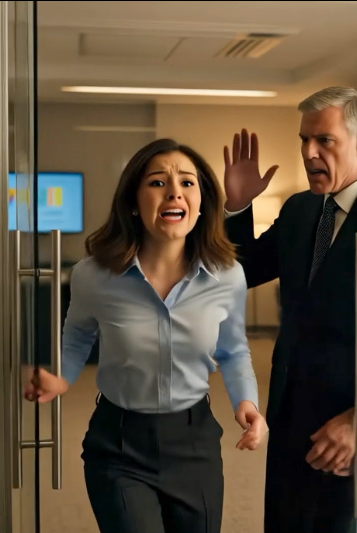
“Security will escort you out, Olivia.”
I stared at Vincent Harrington, our CEO, unable to process his words. Through his office window, I could see Diana Chen in the conference room, basking in applause. My applause. For my campaign.
“I’m sorry, what?” My voice came out strangled.
“Your position has been eliminated. Effective immediately.” He didn’t even look up from his papers, his silver hair catching the afternoon light. “Diana’s brilliant presentation this morning proved we need senior-level strategic thinking. Junior positions like yours are redundant.”
The irony would’ve been funny if my entire world wasn’t collapsing. “Mr. Harrington, that presentation—”
“Was exactly the innovation we need. I suggest you leave quietly, Ms. Parker. Your severance depends on it.”
Four hours earlier, I’d been sitting in my cubicle, putting the final touches on the campaign that would save my job. Maybe even get me that promotion I’d been chasing for two years.
The office at Luminaire Cosmetics hummed with nervous energy. Everyone knew layoffs were coming. Our GenZ cosmetics line was dying, hemorrhaging money, and someone had to take the fall.
I was the obvious choice—twenty-six, mousy-haired, perpetually overlooked Olivia Parker, junior marketing associate who’d never quite had the confidence to shine. My cubicle was wedged between the printer and the bathroom, decorated with motivational quotes I’d stopped believing in.
But this campaign—this was different. Three months of secret work. Hundreds of hours of research, consumer surveys I’d conducted on my own time, an entire strategic framework built from scratch. “Authenticity First: Real Skin. Real Stories. Real You.”
It was good. Better than good. It was career-changing.
“Olivia? You busy?”
I looked up to find Diana Chen standing at my cubicle’s entrance, coffee in one hand, her phone in the other. She was everything I wasn’t—thirty-eight, polished, powerful. Senior Marketing Director with a corner office and a reputation for ruthless brilliance. Designer burgundy suit, black hair in a perfect chignon, the kind of bone structure that made everyone listen when she spoke.
“Just finishing something up,” I said, minimizing my presentation.
“I won’t keep you. I’m presenting to the board this afternoon—a campaign to save our GenZ line.” She smiled, warm and conspiratorial. “I used those ideas you sent me last week. They were perfect.”
My blood went cold. “What ideas?”
“The ones you emailed me? Your thoughts on authenticity marketing?” She tilted her head, confused by my confusion. “You said I could use them for the collaboration we discussed.”
“Diana, I never—we never discussed collaboration. You asked me to send you my perspective on GenZ consumers. For your reference.”
Her expression shifted, something predatory sliding behind her eyes before the warmth returned. “Olivia, sweetie, when a director asks a junior associate for input, that is collaboration. That’s how mentorship works.” She checked her watch—a Cartier that cost more than my car. “Anyway, board meeting in ten minutes. Wish me luck!”
She walked away, leaving me frozen. The email. I’d sent her everything—my entire campaign framework, thinking she genuinely wanted to help me grow. Thinking someone finally saw my potential.
I’d titled it: Initial thoughts on GenZ positioning—hope this helps!
She’d replied: Exactly what I needed. You’re brilliant.
I thought she meant for my future presentation. For the junior-level pitch I’d been preparing to present to her next week, hoping she’d champion it up the chain.
Instead, she’d stolen it all.
I ran to the conference room, arriving just as Diana began. Through the glass walls, I watched her click through slides that made my stomach drop.
My color palette. My tagline. My influencer partnership model. My media timeline. Even my hand-drawn sketches, now digitized and professionally rendered.
The board members leaned forward, engaged. Vincent Harrington was actually smiling.
I burst through the door. “Stop. That’s my campaign.”
Every head swiveled toward me. Diana’s face registered perfect surprise. “Olivia? What are you—”
“That’s my work. All of it. I can prove—”
“Ms. Parker.” Vincent Harrington’s voice could freeze fire. “You’re interrupting a board presentation.”
“Because she stole my campaign! I sent it to her last week, and she—”
“Took your collaborative input and developed it into something boardroom-ready,” Diana interrupted smoothly. “Which I specifically told you I would do. Olivia, I appreciate your enthusiasm, but this is inappropriate.”
“I never agreed to—”
“Enough.” Harrington stood, his jaw tight. “Security, please escort Ms. Parker to my office. Now.”
Which was how I ended up here, being fired while Diana celebrated my stolen future.
I left Harrington’s office in a daze. My hands shook as I packed my desk—two years of my life in a cardboard box. Coworkers averted their eyes. Only Tyler Rodriguez, a data analyst with kind eyes and coffee-stained ties, stopped by.
“Olivia, this is bullshit. Everyone knows you’ve been working on something big.”
“Doesn’t matter what people know,” I said numbly. “Matters what they can prove.”
“Can you prove it?”
I thought about the email timestamps, the metadata, my research files. “Maybe. But who’s going to believe the fired junior associate over the director they just celebrated?”
Tyler squeezed my shoulder. “I believe you.”
It was something. Not enough, but something.
I was halfway to my car when my phone buzzed. An email from an address I didn’t recognize: VHarrington.Personal@gmail.com
Ms. Parker – Return to my office tomorrow, 9 AM. Bring all original files related to the GenZ campaign. Tell no one. – VH
I stopped walking. Read it again. The CEO’s personal email?
A trap? A test? Or something else?
That night, I barely slept. I arrived at 8:45 AM with my laptop, thumb drives, printed emails—everything. The executive floor was eerily quiet.
Harrington’s assistant, a sharp-eyed woman named Bethany, showed me in. “Coffee?”
“I’m fine, thank you.”
“Trust me, dear. Have the coffee.”
Vincent Harrington sat behind his massive oak desk. But he wasn’t alone. The company’s legal counsel, Amanda Brooks, sat to his right. And on his laptop screen, frozen mid-presentation, was Diana’s stolen campaign.
“Sit, Ms. Parker.” His voice was different today. Careful.
I sat, gripping my coffee.
“After you left yesterday, something bothered me. Diana’s presentation was flawless—too flawless for something she claimed to have developed in two weeks.” He turned his laptop toward me. “Then Bethany mentioned you’d been staying late every night for months. Working on something you wouldn’t discuss.”
My heart hammered. “I was trying to save my job.”
“By creating a comprehensive marketing strategy worth potentially millions?” Amanda Brooks spoke for the first time, her voice crisp. “That’s ambitious for a junior associate.”
“It’s ambitious for anyone,” Harrington corrected. He opened a file folder. “I had IT pull the metadata from Diana’s presentation and your email to her. Want to guess what they found?”
I couldn’t speak.
“Your email was sent at 2:14 AM on January twenty-third. Complete campaign framework, market research, creative direction—everything. Diana’s presentation file was created at 9:47 AM the same day. Ninety-three percent of the content is identical. She changed fonts and added her name.”
Relief flooded through me so intensely I felt dizzy.
“But here’s what’s interesting,” Harrington continued. “I also had IT check when those files on your computer were created. Your initial framework? Started four months ago. You’ve been building this the entire time.”
“I wanted to be ready. For whatever opportunity came.”
“And when Diana asked for your ‘thoughts,’ you saw an opportunity.”
“I thought she was mentoring me,” I admitted. “I thought she’d help me present it. That she saw potential in me.”
Amanda Brooks made a note. “Classic appropriation pattern. Senior employee requests ‘collaboration’ from junior, junior provides work product expecting attribution, senior claims ownership.”
Harrington closed the folder. “Diana Chen is being terminated this morning for intellectual property theft and misrepresentation. I’ve already informed the board.”
The words didn’t feel real.
“Ms. Parker, I owe you an apology. And a job offer.” He slid a paper across the desk. “Senior Marketing Director. You’ll lead the campaign you created. Starting salary one hundred thirty thousand, full benefits, and a bonus structure tied to campaign performance.”
I stared at the number. Triple my old salary. The position I’d dreamed about.
“There’s one condition,” Harrington added. “This situation revealed gaps in our policies. I want you to help rewrite our intellectual property and attribution guidelines. Make sure this never happens to anyone else.”
“I accept. Both the job and the condition.”
He extended his hand. “Welcome to leadership, Director Parker.”
Thirty minutes later, I watched from Harrington’s office as security escorted Diana across the floor. She clutched a small box—her personal effects. Her perfect chignon was disheveled, mascara smudged.
She looked up and saw me through the window. Our eyes met.
The fear and fury in her expression should have felt like victory. Instead, I just felt tired.
“Does it feel good?” Harrington asked quietly. “Watching her fall?”
“No,” I admitted. “It feels necessary. But not good.”
“That’s how I know you’ll be better at her job than she ever was.” He returned to his desk. “People who enjoy the fall usually cause the next one. People who understand the weight of it? They build something that lasts.”
Six months later, the “Real Skin. Real Stories. Real You.” campaign was everywhere. Sales up forty-seven percent. Industry awards. My face in AdWeek.
I had Diana’s old office now—corner view, no rattling radiator, real art on the walls. But I’d changed things. Installed a round table for collaborative meetings. Made my calendar accessible to junior staff. Required written attribution on all campaign materials.
Tyler Rodriguez knocked on my open door, holding two coffees. “Thought you could use this, boss. Budget meeting in twenty.”
I took the cup. “Thanks, Tyler. Actually, I want to talk to you about something. That predictive algorithm you mentioned last week? I think we should develop it. With full credit to you as creator.”
His eyes widened. “Seriously?”
“Seriously. Send me your framework. We’ll discuss how to present it to Harrington together.”
After he left, I turned to my computer and pulled up the new employee handbook section I’d written:
All intellectual property created by Luminaire employees remains attributed to its creator, regardless of hierarchy. Collaboration requires written agreement from all parties. Misappropriation of another employee’s work constitutes grounds for immediate termination and potential legal action.
It wouldn’t save everyone. But it might save someone.
I thought about Diana sometimes—wondered where she’d landed, if she’d learned anything. Probably not. People like her rarely did.
But I’d learned something: The best revenge isn’t watching someone fall.
It’s building something so good, so authentic, so real that their theft becomes obvious by comparison.
And then? You change the system so the next person doesn’t have to fight the same battle.
My phone buzzed. A message from a junior associate named Jordan Lee: Director Parker, could I get your thoughts on an idea I’m developing? I’d love your mentorship.
I smiled and typed back: Absolutely. Let’s schedule time to discuss YOUR vision and how I can support it. Bring your files—I want to see what you’ve created.
The difference was in the details. Always in the details.
Justice isn’t always immediate. But when it comes, it should build something better than what came before.
That was the twist Diana never saw coming: She didn’t just lose a job. She lost to someone who’d make sure her tactics wouldn’t work on anyone else.
And that was worth more than any corner office.
Leave a Reply