The studio smelled like hairspray and ambition — two things that, in Meredith Crane’s experience, rarely produced anything honest.
Studio 4 of WKNT Channel 9 buzzed with the controlled panic of a live broadcast three minutes from air. Technicians in headsets threaded between camera rigs, a floor director mouthed countdowns to no one in particular, and the set — a gleaming crescent of blue glass and chrome — sat under lights so white they erased shadows entirely. It was the kind of light designed to make everyone look equally trustworthy.
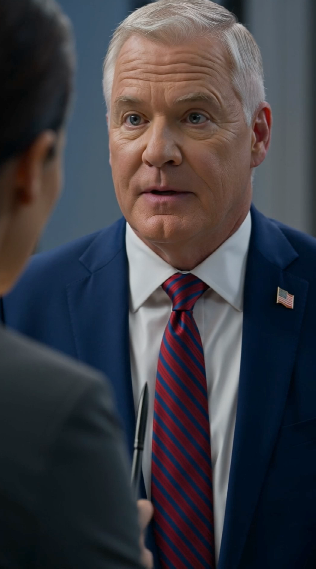
Governor Randall Holt III stood beside the anchor desk, shaking hands with the station manager and laughing at something that wasn’t funny. He was fifty-four, silver-haired in the distinguished way that campaign consultants specifically requested, with a jaw that photograph well and eyes the color of a river you wouldn’t trust. He wore a navy suit, American-flag pin, and the practiced ease of a man who had never once in his adult life been caught off guard.
He was about to be.
“Governor, this is Meredith Crane — she’ll be conducting today’s segment.” The station manager gestured toward the anchor chair.
Randall turned, and for exactly one-third of a second, his face did something involuntary. A flicker. A hiccup in the machinery. Then the smile returned, broader, presidential, utterly opaque.
Meredith Crane was thirty-eight, with dark hair pinned back so severely it looked like a decision. She had sharp cheekbones, a stillness about her that interviewees always mistook for deference, and the kind of beauty that didn’t ask for anything from the room. She wore a charcoal blazer with no jewelry. She extended her hand.
“Governor.” Her voice was a frequency — calm, warm, unmistakable.
“Ms. Crane.” He shook her hand exactly one second too long.
She smiled at him the way you smile at someone you once knew the middle name of.
The broadcast opened cleanly. Meredith introduced him with precision — three terms in the state senate, two as governor, the infrastructure bill, the education reforms, the approval ratings. She was good. She was very good. Randall Holt had been interviewed two hundred and forty-six times in his career. He knew what good looked like.
“Governor,” she began, crossing her legs and tilting her head with the soft curiosity of a therapist, “you’ve described your family as your ‘anchor.’ Tell me — what does your wife, Patricia, think about your decision not to seek federal office?”
He answered smoothly. Patricia was supportive. Patricia was extraordinary. Patricia was the reason he remained grounded.
“Grounded.” Meredith repeated the word gently, as if handling it. “Interesting. I ask because I’ve always been curious about men who use the word ‘anchor’ for their wives.” She glanced at her notes. “Do you think anchors hold things in place — or do they just prevent things from moving forward?”
A murmur moved through the control room. The producer, Danny Okafor, leaned toward his monitor.
Randall blinked. “I think — it’s a metaphor, Meredith.”
“Of course.” She smiled. “Governor, you and Patricia have been married — twenty-two years now?”
“Twenty-three.”
“Twenty-three.” She wrote something down, although she hadn’t written anything during the first half of the interview. “And you’ve said publicly that marriage requires, quote, ‘radical honesty.’ Is that still your position?”
The lights felt hotter. He couldn’t say why.
“Radical honesty, yes,” he said. “Transparency with the people you love.”
Meredith nodded slowly. “And yet you’ve also said — this was four years ago, a commencement address at Whitfield College — that the greatest skill in public life is knowing which truths belong in a room and which ones belong outside it.” She looked up. “How do those two philosophies coexist for you?”
He smiled the way politicians smile when they’re buying half a second. “Context is everything.”
“Isn’t it just.” She uncrossed her legs. “Let me ask you something more personal, Governor. You’ve spoken about your son, Cooper — sixteen now? He plays lacrosse?”
“He does.”
“Beautiful. My — ” She paused. The pause lasted one breath longer than it should have. “I’ve always thought lacrosse was a sport that required a kind of discipline most adults never develop.” She smiled. “You must be proud.”
“Every day.”
“Every day.” She tilted her head again. “Governor, when did you and Patricia decide to stop — or start, rather — having children? Was that a mutual decision?”
In the control room, Danny Okafor said, very quietly, “What is she doing?”
On set, Randall Holt said, “That’s a fairly personal question, Meredith.”
“I apologize.” She didn’t look apologetic. She looked like someone who had waited a long time to be in a room with precise lighting. “Let me rephrase. You’ve positioned yourself as a family-values candidate. Do you believe — genuinely believe — that the choices a man makes in private don’t define him publicly?”
Silence. Not the comfortable silence of a pause, but the kind that has texture.
“I believe,” he said slowly, “that people are more than their worst moments.”
“Of course they are.” She nodded. “Though I’d push back, gently, on the word ‘worst.’ Sometimes our most defining moments don’t feel like failures at the time. Sometimes they feel like — ” she glanced down at her notes one final time, then set them aside entirely, ” — urgency. Don’t you think?”
He looked at her.
She looked at him.
The camera, which had no feelings and no memory and no stake in anything, kept rolling.
It wasn’t until after the broadcast — after the handshakes and the green room coffee and the SUV pulling back onto the interstate — that Randall Holt’s communications director, a lean, nervous man named Phil Garrett, pulled out his phone and Googled the name.
Meredith Crane. Previously Meredith Alcott. Formerly a correspondent with the Burlington Ledger. Before that, a political writer for the Sentinel-Tribune. Before that —
Phil looked up from his phone. Through the tinted window, the city passed in silence.
“Governor.”
Randall was staring at something outside the glass that wasn’t there. “I know,” he said.
“She was — “
“I said I know, Phil.”
Phil set his phone down. In four years on staff, he had never heard Randall Holt’s voice do what it had just done — not break, not crack, but thin. Like paper held up to light.
Outside, three hundred miles away, in an apartment above a dry cleaner on Harwell Street, Meredith Crane sat at her kitchen table still in her blazer and charcoal heels. She poured two fingers of bourbon she wouldn’t drink and opened her laptop to the only file she hadn’t deleted in four years: a single photograph, a single date, a single line of text she’d written to herself the night he stopped answering her calls.
She hadn’t planned to say any of it. Not the anchors, not the honesty, not the thing about defining moments.
Or maybe she had planned all of it.
She still wasn’t sure which answer frightened her more.
Leave a Reply