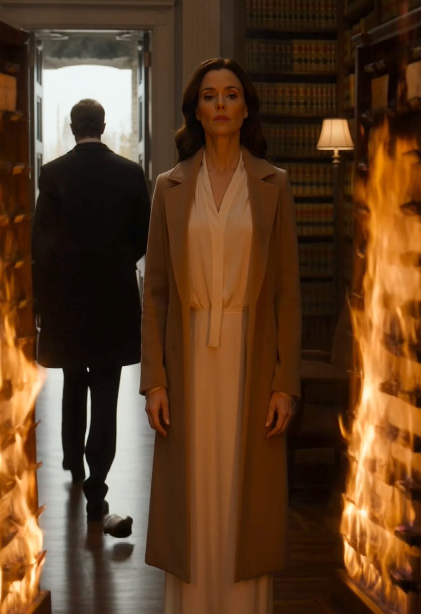
The night Harlow Vance burned down the Meridian Public Library, his wife was inside it — not fleeing the flames, but standing absolutely still among them, watching the card catalogues curl like dying hands, deciding she felt nothing for him anymore.
Serena Vance had everything the glossy magazines promised happiness looked like: a Colonial Revival home in Alderton Hills, a hedge-fund husband with sculpted jaw and curated cruelty, and a wardrobe that cost more than most people’s cars. At thirty-five, she was the kind of beautiful that made strangers uneasy — too composed, too still, like a painting that had somehow learned to breathe. She had married Harlow at twenty-six because he had looked at her like she was a prize he intended to keep, and she had confused possession for devotion.
The library had been her escape. Every Tuesday and Thursday, she arrived at 9 a.m., ostensibly to research her abandoned doctoral thesis on 19th-century botanical illustration. In truth, she came for the quiet. And then, gradually, she came for Edmund Cole.
Edmund was fifty-five and looked every year of it — not in a ruined way, but in the manner of old furniture: worn smooth in exactly the right places. He had silver hair kept slightly too long, reading glasses he was always misplacing, and hands that moved over book spines the way a pianist moves over keys. He had been the head librarian at Meridian for twenty-two years. He had never married. He kept a small cactus named Ptolemy on his desk and talked to it when he thought no one was listening.
Their first real conversation happened over a disputed first edition.
“This is shelved incorrectly,” Serena said one morning, holding a battered copy of The Awakening she’d found in the wrong section.
Edmund looked up from his cataloguing. “It’s exactly where I put it.”
“It belongs in American Literature. This is the Women’s Studies shelf.”
“Does it matter where a book is, as long as someone finds it?”
She had looked at him then — really looked — and said, “I suppose that depends on whether you’re looking for it.”
He smiled. It rearranged his whole face.
It happened slowly, the way water erodes stone: imperceptibly, and then all at once. They began staying past closing, Edmund locking the front doors while Serena read aloud from whatever she’d pulled from the shelves. He would listen and annotate in the margins of his own memory. She would watch him think, fascinated by a man who was in no hurry to finish a thought.
“You’re not what Harlow would call successful,” she told him one evening, not unkindly.
“No,” Edmund agreed. “But I’m not what I’d call lost, either.”
She kissed him first. He held very still, like a man who had stopped expecting certain things and didn’t quite believe they were happening. Then he held her face in both hands, gently, the way he held books he was worried about damaging.
They never spoke of a future. They existed in the present tense of Tuesday and Thursday.
Harlow found out the way men like Harlow always do: by paying someone else to look. A private investigator. Photographs taken through the tall library windows, amber light inside, two figures in conversation too intimate to be casual.
He did not confront Serena. He did not call a lawyer. Harlow Vance had made his fortune by identifying what people valued most, and destroying his competition by removing it.
He came on a Wednesday night with two cans of accelerant and the particular calm of a man who has talked himself into something unforgivable.
The fire started in the rare books room. By the time the alarm triggered, the east wing was already consuming itself. Edmund arrived at dawn to find the shell of the building still smoking, firefighters coiling hoses in the grey light. Twenty-two years of his life. The cactus named Ptolemy, sitting on a desk he would never find again.
He sat on the curb across the street for a long time, not crying, just watching the smoke.
Serena was already there. She had driven over the moment she saw the news alert. She sat beside him without touching him, both of them looking at the ruin.
“He did this,” she said. It wasn’t a question.
“You don’t know that.”
“I know Harlow.”
Edmund said nothing. He picked up a piece of ash that had drifted to his shoe, looked at it, let it go.
“You have nothing now,” Serena said, quietly.
“I have what I remember of it.” He tapped his temple. “Every book. Every shelf in order.”
She finally took his hand. “That’s not enough, Edmund.”
“No,” he said. “But it’s mine.”
The arson investigation took eleven days. Harlow had been careful, but not careful enough — accelerant residue on a jacket lining, a gas station receipt at 11:47 p.m. three blocks from the library, a security camera he hadn’t noticed. He was arrested on a Thursday morning, which Serena noted with a private, bitter symmetry.
She did not visit him in custody. She sent his lawyer a single document: divorce papers, already signed, with a note in her clean handwriting that read only, I watched you burn the only beautiful thing I had left to lose. I hope you understand what that tells me about what you thought of me.
She found Edmund a temporary position advocating with the city council for the library’s reconstruction. She donated the first substantial sum herself — quietly, anonymously, though everyone in Alderton Hills knew anyway. She did not move in with Edmund. She rented a small apartment near the university and began, at thirty-five, to actually finish her thesis.
On the first Tuesday after the divorce was finalized, she brought Edmund coffee and sat on the steps of the burned-out building with him. The city had finally approved the rebuild. There were blueprints.
“It’ll be better than before,” she said.
Edmund looked at the blueprints, then looked at her. “Most things are, the second time.”
She laughed — a real one, short and surprised. It was the first time he had heard her laugh without restraint.
Above them, the October sky was the particular blue of something that has been cleaned by fire, and the ash in the garden had already begun, quietly, to become soil.
Leave a Reply