The termination letter had already been printed. Aurora could see it from across the glass wall of Colton’s office — her name, in neat serif font, at the top of a cream-colored page. Colton Reed, thirty years old and radiating the particular arrogance of someone who had inherited a company rather than built one, hadn’t noticed her looking. He was too busy straightening his cufflinks.
She was forty-nine, a fact he liked to remind the room of indirectly — jokes about “legacy thinking” and “outdated systems” that always seemed to land whenever Aurora proposed something. Her dark hair, threaded now with silver she refused to dye, was pulled into a knot at the base of her neck. She wore the same black blazer she’d worn for eleven years at Vantage Dynamics. It still fit perfectly.
The company was dying. Everyone knew it. The open-plan office on the fourteenth floor of a building that smelled faintly of mildew and failed ambitions had been losing desks for months — first slowly, then all at once. The carpet was the color of old mustard, the overhead lights buzzed with a low, institutional frequency, and the whiteboard in the main conference room still bore, in red marker, the word PIVOT circled three times from a meeting no one could remember attending.
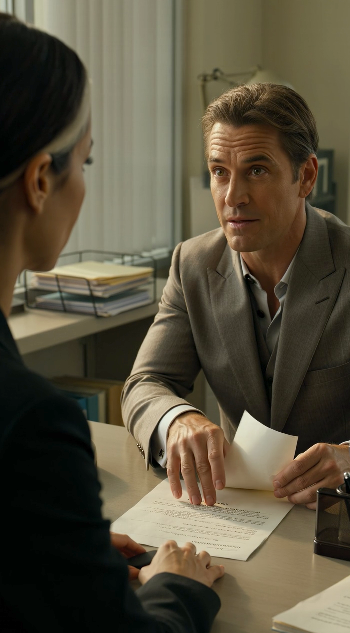
Colton stepped out of his office holding the letter loosely, like a man carrying a used napkin.
“Aurora. Can I see you for a minute?”
She stood without hurrying. Her desk, the last one by the window, was meticulous — no photographs, no plants, nothing personal except a single locked drawer that nobody had ever asked about. She had been careful about that.
Inside Colton’s office, the termination letter sat on the desk between them like a grenade without a pin. He gestured to the chair across from him with the ease of someone who had rehearsed this.
“We’re restructuring,” he said. “Streamlining. You’ve been here a long time, and that matters, but—”
“Colton.” She said his name the way someone might say the name of a town they’d already driven through. “Before you finish that sentence, I need you to look at something.”
She placed a USB drive on the desk. Small, matte black, unremarkable.
He stared at it. “What is this?”
“Eleven years of institutional memory,” she said. “Every vendor contract your father signed that your legal team overlooked. Three acquisition targets your competitors are circling right now because your analytics board flagged the wrong metrics. And—” she paused just long enough, “— the reason Meridian Group quietly withdrew their hostile bid last Tuesday.”
Colton’s hand, which had been moving toward the letter, stopped.
“You knew about Meridian.”
“I’ve known about Meridian for four months.” She let that land. “I also know why they stopped. Because I made sure they did.”
It came out in pieces, the way confessions always do — not one clean reveal but a series of them. Aurora, for eleven years, had been doing something that had no name on any organizational chart. She had been watching. Not out of loyalty to Colton, who had inherited the company at twenty-six when his father’s heart gave out over a balance sheet. Not out of loyalty to the brand, whose logo she privately found gaudy. She had been watching because the company, with all its dysfunction, was built on the work of people she respected — the logistics team who ran on cold brew and stubbornness, the junior analysts who still believed the numbers told the truth.
She had intercepted Meridian’s leaked internal memo through a contact she’d cultivated quietly at an industry conference three years ago — a woman who owed her a favor that Aurora had never called in until now. She had identified the two board members whose votes had been flipped by what she delicately referred to as “incorrect incentives.” She had built an alternative acquisition proposal that reframed Vantage’s liabilities as assets, in language specifically calibrated to the one thing Meridian’s CEO feared: reputational exposure.
“You did all of this,” Colton said slowly, “while I was trying to fire you.”
“You were trying to fire me,” she agreed. “I was trying to save the company. Only one of us was right.”
Colton sat back in his chair. Through the glass wall behind him, she could see the open-plan office — heads down, unaware, the low hum of people working in a building they didn’t know had almost ceased to exist. He looked younger in that moment, and also smaller, in the way that men sometimes do when the room quietly rearranges itself around a woman they underestimated.
He slid the termination letter to the edge of the desk. Then, with two fingers, he turned it face-down.
“What do you want?” he asked.
She had been waiting eleven years for someone to ask her that.
“Chief Operating Officer,” she said. “Full authority over restructuring. And a window in my office. A real one — not the kind that faces the elevator shaft.”
He almost smiled — not with warmth, but with something adjacent to it. Recognition, perhaps. The slow acknowledgment of a man who has just discovered that the most dangerous person in the building had a desk by the window the whole time.
“Done,” he said.
Aurora picked up the USB drive and dropped it into her blazer pocket. She stood, smoothed nothing because nothing needed smoothing, and walked to the door.
She did not look back. She never did. That was the thing about women who spent a decade watching — by the time they moved, they had already seen every exit.
Leave a Reply