The ambulance footage was already looping on every major network by the time Kayla Marsh recognized the broken nose. She’d been eating takeout noodles in her downtown apartment, half-watching Channel 7, when the camera zoomed in on the man being wheeled out of a Tenderloin alley — matted gray beard, a coat that smelled of tragedy even through a television screen, cheekbones split open like ripe fruit. And then she saw it: the hands. Clean fingernails under all that grime. Pianist’s hands. Her boss’s hands.
“Oh, you absolute idiot,” she whispered.
Zachary Wren, 55, was one of the wealthiest men in North America — a man whose penthouse had its own zip code, whose boardroom table was carved from a single sequoia, whose face appeared on the covers of magazines beside words like visionary and titan. He was also, apparently, a man who spent his weekends pretending to be homeless in the roughest neighborhoods in the city, until three teenagers with too much energy and too little conscience had found him sleeping in a doorway and beaten him to the point of hospitalization.
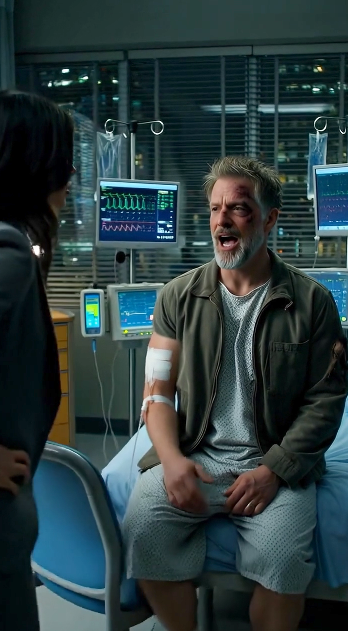
Kayla arrived at St. Carmine’s General on a Tuesday. She wore a charcoal blazer, her natural hair pulled back tightly, the expression of a woman who had rehearsed composure in the elevator. Room 412 smelled of antiseptic and humiliation. Zachary was propped against pillows, his left eye swollen to a plum, two ribs wrapped, a drip in his right arm. Despite everything, he looked pleased to see her.
“You came,” he said.
“Don’t,” she replied, pulling a chair to his bedside with the controlled violence of someone who had a great deal to say and had chosen to weaponize restraint instead. She sat. She looked at him for a long moment. “Zach. Why.”
He shifted against the pillows, winced. Outside the window, pigeons moved along a ledge like small, indifferent executives. “You want the honest answer or the palatable one?”
“I have never once in six years asked you for the palatable one.”
He almost smiled. Then seemed to decide he’d earned the truth. “The first time I did it — three years ago — I told myself it was empathy research. Market insight. Understanding the invisible population.” He paused. “Then one Saturday in February, you walked past me on Polk Street. You were carrying groceries. You stopped and put a twenty-dollar bill in my cup and said, Stay warm, okay? You looked me directly in the face. You didn’t recognize me. And you were the most—” He stopped.
Kayla stared at him. Something cold moved through her chest. “Say it.”
“You were the most real I’d ever seen you. No boardroom armor. No ‘yes, Zachary.’ Just… you. So I kept going back. Every weekend. Hoping you’d walk past again.” He met her eyes. “You did. Eleven times.”
The silence that followed was geological.
“That,” Kayla said finally, very quietly, “is possibly the most romantic and most deranged thing anyone has ever said to me.” She stood, walked to the window, turned back. “You are fifty-five years old, Zachary. You have a therapist, I assume — several, hopefully — and instead of simply talking to me, you chose to impersonate a homeless person and lurk in alleys hoping I’d bring you soup.” She shook her head. “You behave like a child.”
“A child who is worth eleven billion dollars,” he offered.
“Children with money are the worst kind.”
He said nothing. She stayed anyway.
It was another four days before he was discharged — four days during which Kayla visited each evening, initially telling herself it was out of professional obligation, then out of simple honesty abandoning that story. On the third night, she sat beside him for two hours without either of them speaking, and it felt more intimate than any conversation she could remember. On the fourth morning, before the discharge paperwork arrived, she told him she’d known about Nova.
Nova Reyes, 23, was a jewelry designer Zachary had spent three months with the previous year — a luminous, sharp-tongued woman who posted photographs of raw gemstones and had seventeen times more emotional intelligence than anyone gave her credit for. The relationship had ended, Kayla had heard through sources she’d never admit to having, because Nova herself had walked away. He’s in love with someone else and doesn’t know how to stop being cowardly about it, she’d reportedly told a mutual friend.
“I know about Nova,” Kayla said, standing at the foot of his hospital bed, coat already on. “I’ve known for almost a year. And I want you to understand that I forgive you for it — not because it didn’t hurt, but because you don’t belong to me. You never asked to. And I never asked you to.” She buttoned the top button of her coat. “What I’m less willing to forgive is three years of theater when a single honest sentence would have sufficed.”
Zachary was quiet for a moment. Then he reached under the thin mattress — and produced a ring. A plain gold band, unadorned, slightly scratched, the kind of thing a man bought not to impress but to mean. Kayla stared at it. He must have had someone bring it. He must have been planning this longer than she’d realized.
“I bought this eight months ago,” he said. “I’ve been carrying it in my coat pocket every Saturday and Sunday.” He looked at her. “In case you walked past again.”
Kayla stood very still. Outside, a siren moved through the city — urgent, searching, already fading.
“You are,” she said, “a profoundly strange man.”
“Yes.”
She looked at the ring for another long moment. Then, without a word, she held out her hand — not reaching for it, not refusing it. Simply offering him the choice of where the story went next. He slid it onto her finger. It fit perfectly. Of course it did. He’d been watching her for three years.
Leave a Reply