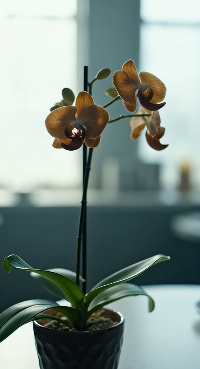
The orchid on Table 9 was dying, and nobody noticed but Callie Voss.
She noticed everything — the way the ice machine gurgled before it jammed, the way the Thursday lunch crowd tipped worse after the market dipped, the way the man in the charcoal suit had been sitting in her section every Tuesday for six weeks without ordering anything heavier than black coffee and a side of regret.
His name was Warren Aldridge. Fifty-one, steel-gray temples, the kind of tan that came from a yacht rather than a beach chair. He ran Aldridge Capital, a private equity firm that occupied the top three floors of the Hargrove Tower downtown — the building visible from every window of the diner where Callie worked double shifts to pay for her mother’s physical therapy.
“You changed the orchid,” he said one Tuesday, without looking up from his phone.
“Wrong. I moved it closer to the window. It was sulking.”
He looked up then. Really looked. “Plants sulk?”
“Everything sulks if it’s in the wrong light.”
She walked away. He left a hundred-dollar bill under the saucer.
Warren Aldridge had been married for twenty-two years to Diane Aldridge — born Diane Hargrove, as in the Hargrove Tower, as in old money older than his ambition. Diane was fifty-three, fine-boned, and precise in the way of a woman who had spent decades curating herself into an asset. She sat on four charitable boards, wore couture to gallery openings, and had not eaten bread since 2009. Their home in Chestnut Hill had eleven rooms, a wine cellar, and a chill that had nothing to do with the central air.
Their son, Bryce, twenty-four, worked at the firm in a role that had no real title and no real function. Their daughter, Morgan, twenty-two, was in Florence, studying art history and spending freely.
No one in the family was unhappy, exactly. They had simply agreed, without saying so, to stop checking.
— • —
Callie Reyes Voss was twenty-six. She had a community college degree, a landlord who ran the heat only on Sundays, and a laugh so sudden it made strangers flinch. She was not trying to be noticed. She was trying to save twelve hundred dollars to buy her mother a proper recliner that wouldn’t aggravate the nerve damage.
Warren began arriving on Thursdays too.
Then Mondays.
“You went to school for what?” he asked one afternoon.
“Business administration. Dropped out semester four.”
“Why?”
“Mom got sick. Took this job. Never entirely left.” She refilled his coffee. “Why do you care?”
“Because you run this room better than my senior VP runs his department.”
She laughed — the sudden kind. “One diner with eleven tables is not comparable to a private equity firm, Mr. Aldridge.”
“You’d be surprised how much the principles overlap.”
He was not wrong. And she was not unaware of what was happening. She simply did not expect it to become what it became.
— • —
Warren told Diane on a Thursday in November, in the kitchen, while she was arranging ranunculus in a crystal vase. He did not soften it. He had prepared remarks and abandoned them.
“I’m in love with someone else. I’d like a divorce.”
Diane set down the flower she was holding. She did not cry. She did not throw the vase, which cost more than Callie’s monthly rent. She simply looked at him the way one looks at a contract that has been breached, cataloguing the damage with professional detachment.
“Is she young?”
“Yes.”
“Is she poor?”
He hesitated. “She’s a waitress.”
Diane picked the flower back up. “All right,” she said. “All right.”
Those two words should have frightened him. They did not, because Warren Aldridge had built a career on underestimating quiet.
— • —
The divorce took fourteen months. Warren moved into a penthouse in Rittenhouse Square. Callie moved in six months after, still unconvinced, still watching the orchid he bought for the kitchen counter with a skepticism that softened, slowly, into something she didn’t have a word for yet.
They married the following spring in a ceremony of twelve people. Callie wore a silk dress the color of fog. Her mother cried from the recliner Warren had bought her — not the twelve-hundred-dollar one, but one that cost four times that, with lumbar heat.
By autumn, Callie was Deputy Director of Operations at Aldridge Capital.
“This is insane,” she told him the first morning she had her own office. She stood at the window, looking down at the street — twelve floors below, the diner still visible, its neon sign blinking the way it always had.
“You’re the most operationally intelligent person I’ve encountered in thirty years of business,” Warren said from the doorway. “The insane thing would be wasting that.”
“Your staff despises me.”
“My staff respected no one until they had a reason to. Give them a reason.”
She did. Within eight months, Callie had restructured three internal teams, cut administrative overhead by nineteen percent, and earned a cautious, grudging respect that she preferred to affection because it was harder to fake.
No one sent her flowers of congratulation. But no one dismissed her twice.
— • —
Diane had not been idle.
The prenuptial agreement Warren had signed twenty-two years ago — the one drafted by Diane’s father’s attorneys, the one Warren had never read carefully because he had been thirty and dazzled and certain he would outgrow the need for anyone else’s money — contained a clause on page forty-one that his own lawyers had missed during the divorce proceedings.
It was not about infidelity.
It was about the building.
Specifically: that any commercial property acquired with commingled Hargrove capital during the marriage reverted to Diane’s trust upon dissolution of the marriage, provided dissolution was initiated by Warren. The Hargrove Tower — the building Aldridge Capital had leased its flagship offices in for nineteen years, the building that gave the firm its most prestigious address, its most important client associations — had been purchased using a bridge loan co-signed by Diane’s family trust in 2007.
Warren’s lawyers discovered this on a Wednesday.
On Thursday, Diane’s attorneys filed.
By Friday, the firm received notice to vacate within ninety days.
Warren called Diane from his car, in the parking garage, his voice doing something it had not done in years.
“You planned this from the beginning.”
“No,” she said. “I planned for the possibility. The way you plan for a market correction. You hope it won’t happen. But you prepare.”
“You’re going to destroy twenty years of what I built.”
“You destroyed twenty-two years of what we built. I’m simply itemizing the wreckage.”
She hung up.
— • —
The office evacuation was public. The financial press found it before Warren’s PR team could shape the narrative. Three anchor clients suspended their accounts pending “operational stability review.” Bryce resigned rather than publicly back his father. Morgan stopped returning calls.
In the middle of it, Callie sat across from Warren in the kitchen with the orchid between them and said nothing for a long time.
“She’s going to win,” Callie finally said.
“Not entirely.”
“She doesn’t need to win entirely. She needs to cost you enough that you feel it every day. That’s not winning. That’s precision.” Callie looked at the orchid. It was blooming — she’d moved it to the right window. “I think I understand her.”
Warren looked at his wife. “That’s a terrifying thing to say.”
“She spent twenty-two years learning your architecture, Warren. Every beam. Every load-bearing wall. And then she waited for you to hand her the reason.” Callie set down her coffee. “I would have done the same thing.”
He stared at her.
“I’m not saying I will,” she added. “I’m saying I understand the logic.”
— • —
Aldridge Capital survived, relocated, smaller. Two of the three suspended clients returned. Warren lost eleven million in the transition. It was not nothing, and it was not everything.
Diane donated the Hargrove Tower to a university foundation eighteen months later, taking the tax write-off and ensuring Warren could never buy it back. It was the kind of move that was both generous and annihilating, and everyone in their world knew which it primarily was.
On the day the donation was announced, a single orchid arrived at Callie’s office. White. No card.
Callie set it on the windowsill and watched it for a long time.
She did not move it. She waited to see which direction it would reach.
That, she had learned, told you everything you needed to know.
Leave a Reply