He had never once considered that a woman might be watching him the way a chess player watches a board — not with desire, but with the cold patience of someone who has already planned the endgame.
I. The Predator
Samuel Holt occupied the corner office on the fourteenth floor of Meridian Partners like a man who had been born to be there. At forty-four, he was formidably handsome in a worn, expensive way — broad-shouldered, dark-haired at the temples where silver had begun its slow advance, with green eyes that projected warmth as effortlessly and insincerely as a stage light. He had founded the firm on nerve and borrowed capital, and in twelve years had made it into one of the most feared acquisition houses in the city. His desk was mahogany. His suits were bespoke. His conscience was decorative.
The women of Meridian Partners understood Samuel Holt through accumulated evidence. There had been Diane from Legal — brilliant, unsuspecting — who left after four months and a “restructuring package” that looked very much like a bribe. Before her, Annalise from Risk Management, who transferred to the London office and never came back. The pattern was a known thing, passed in low voices between the coffee machine and the elevator: Samuel selected, pursued with extraordinary charm, and discarded. He was, as one assistant put it, a man who treated human hearts like quarterly reports — useful for a season, then filed away.
II. The Architect
Margaret Cross arrived at Meridian Partners on a gray Monday in October, carrying a leather portfolio and a silence that felt deliberate. She was thirty-eight, with a quiet, angular face and dark eyes that held a quality Samuel would later describe to himself as depth, though the more accurate word was calculation. She had come from Hargrove & Finch — a firm Samuel had absorbed three years prior, dismantling it surgically and without sentiment. Margaret had been its most talented analyst. She had watched her colleagues scattered like papers in wind.
She had not forgotten. She had simply waited.
Her references were immaculate. Her interview was flawless. Samuel hired her in under fifteen minutes and congratulated himself on his instincts. He did not yet understand that his instincts were precisely what she had counted on.
III. The Game Within the Game
By November, Samuel had begun finding reasons to linger near Margaret’s office. She worked late, which he admired. She pushed back on his ideas, which unsettled and thrilled him. He was not accustomed to resistance.
“The Calloway projection is wrong,” she told him one evening, her eyes on her screen. “You’ve assumed a stable credit window that closed six weeks ago.”
Samuel leaned in the doorway. “My analysts signed off on it.”
“Your analysts,” she said evenly, “are afraid of you.”
He laughed — a genuine, slightly disoriented sound. He came back the next evening. And the one after.
By December they were having dinner. By January he was confessing things: his father’s debts, the years of controlled hunger, the fear of collapse that lived permanently beneath the confidence like a fault line. Margaret listened with extraordinary attention. She asked careful questions. She forgot nothing.
“I’ve never talked to anyone like this,” he told her over wine one night, the city lit up beyond his penthouse windows.
She looked at him steadily. “I know,” she said. And smiled.
IV. The Fall
What Samuel did not see — could not see, having spent years looking at women and never really watching them — was the architecture of his undoing being built quietly around him.
A word to a journalist here: a rumor about Meridian’s exposure in an unstable Asian fund, sourced by “a former associate.” A quiet lunch between Margaret and Samuel’s most nervous investor, Raymond Falk, in which she said almost nothing alarming — only the right things, in the right order, with the right pauses. A strategic delay in the Brennan acquisition paperwork that triggered a penalty clause Samuel’s attorneys had flagged once, eighteen months ago, in a memo he had not read.
The dominoes fell slowly, then all at once. Three investors withdrew by March. The Brennan deal collapsed in April, taking with it the credit line that underwrote Meridian’s three largest positions. By May, Samuel Holt — the man who had built everything on nerve and borrowed capital — was standing in front of his own lawyers, signing the first of the documents that would begin the formal dissolution of the firm.
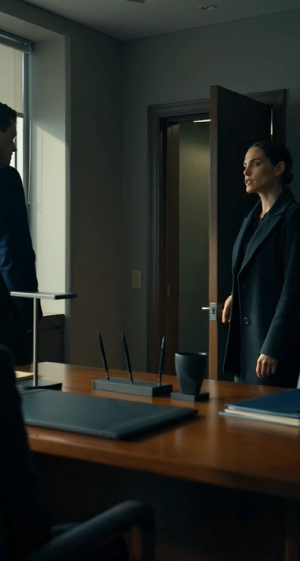
The corner office on the fourteenth floor smelled, that last morning, exactly as it always had: leather, ambition, and a cologne that cost more than some people’s monthly rent. Samuel stood at the window. He heard the door open behind him and knew, without turning, that it was her.
“You could have just quit,” he said. His voice was calm. He had earned that much.
“You could have just been decent,” Margaret replied. She set her access badge on his desk. “We both made choices.”
He turned then. He looked at her for a long time. “Was any of it real?”
She considered this honestly, in the way she considered everything. “The part where I felt sorry for you,” she said. “That part was real.”
“And the rest?”
“The rest was Hargrove & Finch.” She picked up her portfolio. “Diane sends her regards, by the way. And Annalise.”
She walked to the elevator. The doors opened, swallowed her, and closed.
Samuel Holt stood alone in the office that was no longer his, in the building that would be sold by autumn, and looked out at the city he had once believed he owned. Below, fourteen floors down, a woman in a dark coat crossed the street without looking back — unhurried, precise, and entirely free.
The predator, it turned out, had been the bait.
Leave a Reply