A Story of Power, Secrets, and Consequences
The corner office on the thirty-second floor smelled of ambition — cedar from Sophia Marlowe’s custom desk, cold espresso, and something sharper underneath. Fear, perhaps. Michael Drane had always been good at detecting it.
He was thirty-four, lean in the way of a man who ran not for pleasure but for control, with a jaw that always looked slightly clenched and eyes the colour of wet slate. He had worked under Sophia for three years at Aurelius Capital — long enough to notice everything, patient enough to wait.
Sophia was forty-one and built her career like a fortress: methodical, brilliant, impenetrable. She wore her dark hair pinned up, her suits charcoal or black, her expression one of calculated serenity. She had a husband — David Marlowe, a quiet architect who trusted her completely — and a reputation she had sacrificed a decade to construct.
It was a Tuesday in October when Michael closed her office door without being invited to.
“Michael.” Her tone was a warning dressed as a greeting.
“I’ll be brief.” He sat down across from her without being invited to do that either. From the interior pocket of his jacket, he produced his phone and slid it across the glass desk. On the screen was a photograph. Barcelona, last June — the company retreat. A hotel rooftop, fairy lights strung across warm Spanish air. Sophia, her jacket off, laughing into the neck of a man whose arm wrapped around her waist, lips brushing her cheek. The man was not David.
Sophia did not touch the phone. She looked at it the way you look at something you hoped had burned. Then she looked up.
“The position of Senior Director of Acquisitions opens in December,” Michael said pleasantly. “I’d like it.”
“You’re not qualified.”
“I’m aware. You’ll qualify me.” He leaned back. “There are twelve more photos, Sophia. Some are ambiguous. Some aren’t. David strikes me as the type who would find them very clarifying.”
The silence in the room was extraordinary. Outside, thirty-two floors below, the city moved and breathed and had no idea.
“Get out of my office,” she said quietly.
“Of course.” He stood, took his phone, and buttoned his jacket. “Take the weekend to think. I’m patient.” He smiled — the particular smile of a man who believes he has already won — and left.
* * *
She gave him the promotion. Announced three weeks later in a company-wide memo that cited his “exceptional strategic vision.” Michael received congratulations with becoming modesty, shook hands, and moved into a larger office two doors down from hers. He began cc’ing her on emails as though she were his assistant. He called her by her first name in meetings where he never had before.
Sophia said nothing. She learned, instead, to be a different kind of patient.
She began to watch him the way he had once watched her.
* * *
It took her four months. Michael Drane, it turned out, had leveraged more than photographs. Over eighteen months, he had been quietly redirecting client funds — small amounts at first, routed through a shell company he’d registered in his mother’s maiden name in Delaware. Then less small. Then not small at all. He had been meticulous about it, the way careful people are meticulous, which meant he had left exactly the kind of traces that only someone looking very hard would find.
Sophia found them.
She didn’t call him into her office. She didn’t warn him. She sent the full documentation — wire transfers, shell company filings, internal access logs, a three-page forensic summary prepared by a white-collar attorney she’d retained in November — to the company’s general counsel and the FBI Financial Crimes Unit on the same Tuesday morning in February, at 9:04 a.m.
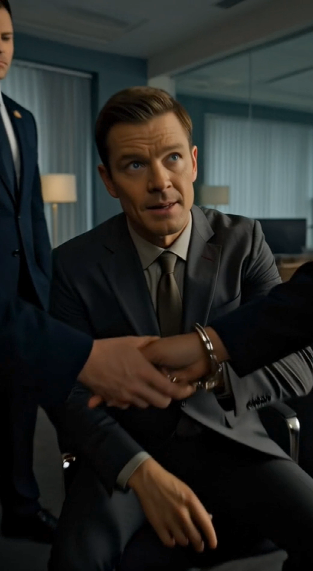
At 11:47 a.m., two federal agents walked through the lobby of Aurelius Capital.
Michael was at his desk reviewing a report on a luxury hotel acquisition in Geneva when his office door opened. He looked up expecting his assistant.
He did not see his assistant.
Later, witnesses would describe the sound of his chair scraping back too fast, the clatter of his coffee cup going over the desk’s edge, the word he said — just one word, short and ugly — before he understood that the sound of handcuffs was not the sound of a person getting what they want.
* * *
Sophia was in a board meeting when it happened. Someone’s phone buzzed; someone leaned over to someone else; the whisper moved around the table like a current. She did not look up from her notes.
After the meeting, her assistant hovered in the doorway. “Ms. Marlowe — did you hear about Michael?”
“I heard.” She capped her pen.
“It’s — I mean, apparently he’s been—”
“I know what he’s been doing, Claire.” She picked up her portfolio. “Cancel his access credentials and have his office cleared by end of day. And please have someone fix the espresso machine — it’s been running cold all week.”
She walked down the corridor. Her heels were quiet on the marble. At the elevator, she pressed the button for thirty-two and waited, her reflection watching her from the polished doors — composed, dark-suited, unreadable.
There was, perhaps, the smallest curve at the corner of her mouth. The kind that isn’t quite a smile, but is the memory of one.
The doors opened. She stepped in. The city fell away below her, thirty-two floors of consequence, and she rose.
— END —
Leave a Reply