The photograph landed on Margaret Holloway’s desk at 7:42 a.m. — a glossy, 8×10 print of her husband kissing another woman in the elevator of their building. The Holloway Group’s Manhattan headquarters. Sixty-three floors of steel and glass that she had helped build, board meeting by board meeting, compromise by compromise, twenty-two years of marriage that she had apparently been funding with her silence.
Margaret didn’t flinch. She set her coffee down, picked up the photograph with two fingers, and studied it the way she studied quarterly reports — methodically, without sentiment.
Then she smiled.
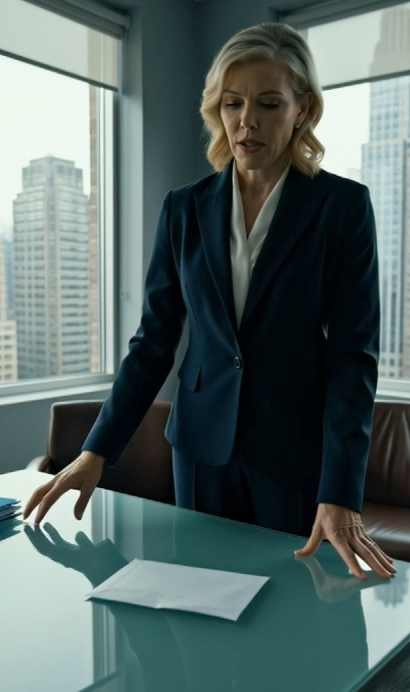
Margaret Holloway, 47, was the kind of woman architects designed rooms around without realizing it. Sharp cheekbones, silver-streaked blonde hair she refused to dye, and gray eyes that registered everything and revealed nothing. She held the title of Chief Brand Officer at Holloway Group — a role her husband, Richard Holloway, had given her the way men give their wives jewelry: lovingly, conditionally, and with the unspoken expectation of gratitude.
Richard, 52, was the kind of billionaire who appeared on magazine covers with his sleeves rolled up, projecting the myth of the self-made man. Broad-shouldered, perpetually tan from the Aspen house, with teeth so white they seemed aggressive. He had built a logistics empire from a regional trucking company, and he never let anyone forget it — not his board, not his executives, and certainly not Margaret.
Cassandra Reeves, 31, was the woman in the photograph. Senior Vice President of Global Partnerships. Honey-blonde, relentlessly ambitious, with a Harvard MBA and the particular hunger of someone who had decided that sleeping your way up was simply a more efficient form of networking. She wore tailored Chanel to quarterly reviews and called everyone in the office “babe” — except Richard, whom she called “sir” in meetings and something else entirely in private.
And then there was Daniel Marsh, 38 — lean, dark-haired, the company’s newly appointed Head of Digital Strategy. He had been recruited away from a Silicon Valley competitor six months ago, reportedly by Margaret herself. Quietly brilliant. Quietly loyal. Quietly in love with Margaret Holloway, though he had never said so aloud, and she had never acknowledged it, because she was very good at choosing what to notice.
The forty-fourth floor hummed with the low frequency of ambition. Glass walls separated glass offices — a fishbowl empire where everyone watched everyone else. That Monday morning, the air carried the particular tension of an upcoming announcement: Richard had hinted to the board that Holloway Group was pursuing a landmark European acquisition, and whoever structured the brand strategy for the merger would effectively become indispensable.
Cassandra knew this. She had spent the weekend at Richard’s Connecticut estate knowing this.
Margaret knew this too. She had found the hotel receipt two months ago.
She had been waiting.
At 9 a.m., Margaret called Daniel into her office.
“Close the door,” she said.
He did. He read her face the way he always did — carefully, the way you read weather.
“I need the Larsen Group integration deck by Thursday,” she said. “Not the version Cassandra’s team is building. Mine.”
Daniel raised an eyebrow. “She’s already presented a framework to Richard—”
“I know what she’s presented to Richard.” Margaret’s voice was perfectly level. “Build me something better. Something real — market analysis, identity architecture, five-year brand equity projections. The board meets Friday. I want them to see the difference between a strategy and a performance.”
A pause. “This is about more than the acquisition,” Daniel said.
“Everything in this building is about more than it appears.” She looked at him steadily. “Can I trust you, Daniel?”
He held her gaze. “You recruited me. You already know the answer.”
By Wednesday, the floor was electric with rumor. Cassandra had heard — through the particular intelligence network of assistants and lunch orders — that Margaret was preparing a competing presentation. She materialized in Richard’s office at noon, perching on the edge of his desk with practiced ease.
“She’s undermining the whole process,” Cassandra said, tucking a strand of hair behind her ear. “It sends a terrible message to the team.”
Richard frowned, spinning a pen between his fingers. “Margaret runs brand strategy. She’s entitled—”
“She’s entitled to support the direction we agreed on.” Cassandra’s voice dropped. “Unless you want to explain to the board why your wife is running a shadow campaign inside her own company.”
Richard’s jaw tightened. He picked up his phone.
Margaret’s cell rang once. She looked at the screen, let it go to voicemail, and kept typing.
Friday morning arrived like a verdict.
The boardroom occupied the entire north face of the forty-fourth floor — panoramic views of Manhattan, a table of white oak, twelve chairs occupied by twelve people who controlled, collectively, several billion dollars of other people’s futures. Richard sat at the head. Cassandra was positioned three seats to his left, her deck printed and bound, her smile calibrated to a precise frequency of confidence.
Margaret walked in last.
She wore ivory — a deliberate choice, clean as a blank page — and carried nothing but a tablet.
Cassandra presented first. It was polished, sweeping, full of synergy language and aspirational graphs. Richard nodded throughout, visibly pleased.
Then Margaret stood.
“Before I begin,” she said, her voice carrying the room without effort, “I’d like to share something with the board.”
She connected her tablet to the display screen. What appeared was not a brand deck.
It was a financial audit.
“Over the past eighteen months,” Margaret said calmly, “Holloway Group has allocated approximately $4.2 million in consulting fees to a shell entity — Reeves Advisory LLC — with no deliverables on record and no vendor approval from finance.” She paused. “The entity is owned by the person who just presented to you.”
The room went very still.
Cassandra’s face didn’t move. But her hands, hidden beneath the table, pressed flat against her thighs.
“Furthermore,” Margaret continued, “I’ve been in contact with the Larsen Group’s actual leadership team this week. They have concerns about the proposed integration timeline — concerns that were never surfaced to this board.” She advanced to the next slide. “I have their trust. And I have a strategy that reflects what they actually need.”
She presented for fourteen minutes. When she finished, she looked at Richard — not with anger, not with triumph, but with something far more devastating: complete clarity.
“The choice,” she said quietly, “is yours. As always.”
Richard resigned from the CEO role eleven days later, citing “personal matters requiring his full attention.” The board appointed an interim chair. Margaret declined the role, recommending Daniel Marsh instead — a gesture the press called selfless and the board understood as something else entirely.
Cassandra Reeves left the company by mutual agreement, with a settlement she was not permitted to discuss.
Margaret kept her office on the forty-fourth floor. She redecorated it — removed the photographs, replaced the glass desk with one of dark walnut, added a single orchid on the windowsill.
She never told anyone who had slipped that photograph under her door.
But sometimes, passing Daniel in the corridor, she caught the faintest trace of a smile — and did not look away.
Leave a Reply