The sea does not forgive fools — and neither, Miles Hartwell had always believed, did he.
At forty-five, Miles was the kind of man who entered rooms and changed their temperature. Tall, silver-templed, dressed in the quiet confidence of old money and new empire, he had built Hartwell Capital from a single office in downtown Manhattan into a billion-dollar institution. He collected art, racehorses, and silence. His wife, Catherine — elegant, perceptive, and long accustomed to his emotional distance — kept their Westchester estate in perfect order and asked no uncomfortable questions. It was, by any measure, a civilised arrangement.
Lily Voss had arrived in his life the way spring arrives after a long winter: suddenly, warmly, and with the particular cruelty of something too beautiful to last. She was twenty-nine, a junior accountant in his firm, with amber eyes that caught light like a glass of cognac and a laugh that could make a boardroom feel like a garden. Miles, who prided himself on self-control, had told himself it was nothing. Then he told himself it was something manageable. By October, he had booked a private Mediterranean cruise for two.
The Stellara — a 140-foot yacht, white as bone against the blue Ionian Sea — carried them through seven days of salt air and recklessness. Lily wore sundresses and expensive sunscreen; Miles wore the expression of a man who had decided, temporarily, not to be sensible. He gave her a watch on the third evening — a 1962 Patek Philippe, his father’s, the only object he owned that he genuinely loved — because she had admired it, and because he was, privately, terrified of how much he wanted her to stay.
On the eighth morning, she was gone.
He noticed the absence first as a small thing: no coffee cup on the breakfast table, no sandals by the stern. He walked every deck twice before going to his stateroom. The Patek Philippe was not on the nightstand. His travel wallet — thirty thousand euros in cash, three credit cards — had vanished from the drawer. He stood very still for a long time, looking at the shape of the indentation her head had left in the pillow, and understood completely.
“She’s gone,” he told the captain, his voice level and entirely without surprise. “She’s not coming back. Don’t contact the authorities.”
“Sir — ”
“Don’t.”
He sat on the deck for the rest of the afternoon and watched the horizon. He was not heartbroken. That was the worst part. He was ashamed — and shame, in Miles Hartwell, ran much deeper than grief.
Three months later, on a wet Tuesday in November, he was walking back from a lunch meeting in the Meatpacking District when he saw her.
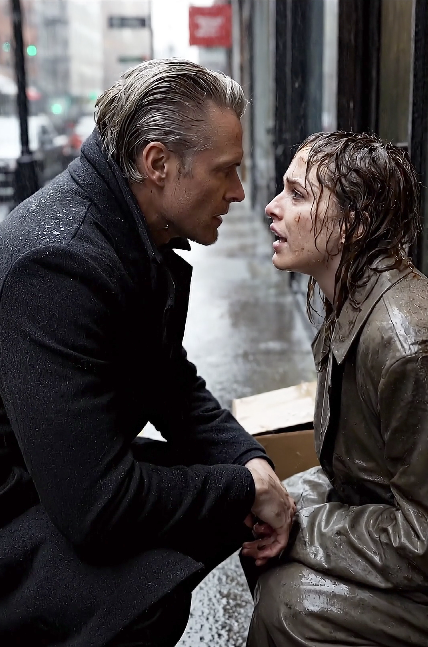
She was crouched in the doorway of a shuttered boutique, half-hidden beneath a flattened cardboard box, wearing a man’s coat two sizes too large and shoes with no laces. Her hair — once the colour of dark honey, always immaculate — was matted against her jaw. Her face, turned down toward the pavement, was hollowed and grey. But the angle of the cheekbone, the particular curve of the wrist: Miles stopped walking as though he had been struck.
He stood there in the November drizzle for a full ten seconds. Then he said, quietly: “Lily.”
She looked up slowly, the way animals do when they expect a blow. Recognition crossed her face like a crack moving through ice — and then something collapsed behind her eyes.
“Miles.” Her voice was hoarse, almost unrecognisable. “I — ” She stopped.
He crouched down to her level. His coat was cashmere; the pavement was wet; he did not appear to notice. “What happened to you?”
“Everything I deserved,” she said. It was not self-pity. It was a fact.
A long silence passed between them, filled with rain.
“The watch,” he said finally. “My father’s watch.”
She closed her eyes. “I sold it. In Athens. I’m sorry, Miles. I’m — the money’s gone too. All of it. I was working with someone. He took everything from me before I even got off the boat.” She paused. “I know that doesn’t fix it.”
“No,” he agreed. “It doesn’t.”
He looked at her for a long moment — this woman he had once confused for something rare — and felt something unexpected: not love, not anger, but a distant, exhausted pity, the kind a man feels when he watches someone drown in a puddle they could simply stand up from.
“Can you work?” he asked.
“I can do anything,” she said quickly, then caught herself. “I can wait tables. I’ve done it before.”
Miles stood up and straightened his coat. He did not offer her his hand.
“I’ll make a call,” he said.
Elias Varda had been Miles’s closest friend since their Columbia days — a warm, broad-shouldered Greek-American who had turned his grandmother’s recipe for moussaka into a small empire of acclaimed restaurants. Miles called him that evening from his car.
“I need a favour. I have someone who needs work. Front of house, nothing complicated.”
“Anyone I know?”
A pause. “Yes. And that’s why I’m calling you directly and not sending a referral. She stole from me, Elias. Significantly. She’s hit bottom now — genuinely, I think — and I want her to have a chance, but I need you to know the whole truth so you can protect yourself.”
Another silence. Then: “You’re a strange man, Miles.”
“I know.”
“Send her in Monday.”
Within the week, Lily Voss was folding linen napkins in the warm amber light of Elias’s restaurant on West 22nd Street, learning the wine list, earning an honest wage. Elias watched her carefully and said nothing beyond what was necessary. She was, by all accounts, a hard and grateful worker.
Miles did not visit the restaurant. He did not call to check on her progress. He felt no pull to do so — and that absence of pull told him everything he needed to know about what he had mistaken, in the blue light of the Ionian Sea, for love.
He had not loved Lily Voss. He had loved the feeling of being a man willing to be reckless — and she had simply been the occasion for it. He was done being reckless now. The watch was gone. He would not replace it.
Catherine was reading when he came home that night. She looked up without accusation, without hunger — just the level, knowing gaze of a woman who had outlasted every storm.
“Dinner?” she asked.
“Please,” he said, and sat down.
Leave a Reply