The operating room smelled of antiseptic and quiet desperation. Dr. Bella Harmon, forty years old, stood beneath the cold fluorescent lights with a scalpel in her gloved hand and a marriage dissolving somewhere in the back of her mind. She had been a surgeon for fifteen years. She had learned to compartmentalize — grief in one drawer, duty in another. But today, the drawers wouldn’t close.
“Pressure’s dropping,” the anesthesiologist, Dr. Marcus Webb, announced from behind his monitor. He was a lean, methodical man who spoke only in facts. “Seventy over forty.”
“I see it,” Bella said, her voice steady even as her vision began to blur at the edges. She blinked once. Twice. The room tilted like a ship caught in a slow wave. Not now. Please, not now.
The scalpel slipped from her fingers, and then so did everything else.
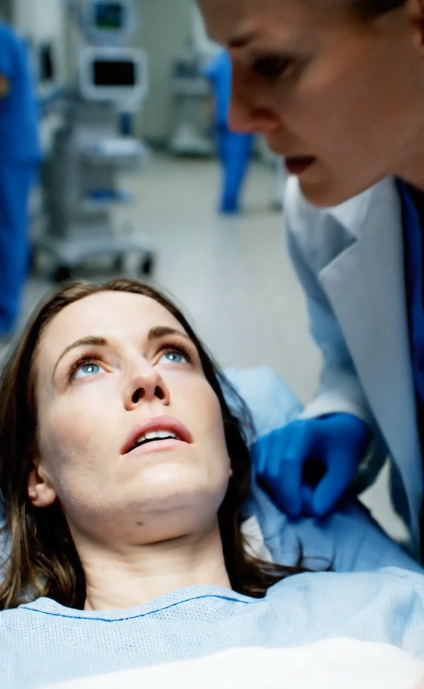
She woke up on a gurney outside her own operating room, staring at the ceiling tiles she had memorized over a decade of long shifts. Dr. Priya Nair, her closest colleague — a compact, warm-eyed woman who wore her silver-streaked hair in a tight bun — was crouched beside her, pressing two fingers gently to Bella’s wrist.
“You fainted, Bella.” Priya’s voice carried equal parts concern and careful restraint. “Marcus finished the procedure. The patient is fine.”
“I’m fine,” Bella said reflexively.
“You’re not.” Priya held up a small paper strip. A test. “They ran a panel when you came in.” She paused, letting the silence do the heavy lifting. “You’re pregnant.”
Bella stared at her. The word landed somewhere between her ribs and refused to move. Pregnant. She was forty, overworked, and her husband had asked her, just three nights ago over an untouched dinner, whether she thought they had anything left worth saving.
Henry Harmon was tall and well-dressed in the way of men who valued appearances above most other things. He was a corporate attorney, forty-four, sharp-jawed and perpetually slightly absent — as though one half of him always remained in a courtroom. When Bella arrived home that evening, still pale from the hospital floor, he was already seated at the dining table with a manila envelope in front of him.
“We should talk,” he said, without looking up.
“So should we,” Bella replied.
He slid the envelope across the table. Divorce papers. Neatly prepared, probably for weeks. She looked at them and then looked at him — at the careful blankness of his expression, at the way he had already emotionally vacated every room in their home before she had even known he was leaving.
“I’m pregnant, Henry.”
The blankness cracked. Just slightly. “What?”
“Eight weeks.” She sat down across from him, not because her legs were steady, but because she refused to let him see them shake. “I found out today. At the hospital. After I collapsed during surgery.”
A long silence followed. Henry rubbed his jaw. His eyes moved to the envelope, then back to her face, cycling between calculation and something older, something that might once have been love.
“I’ll stay,” he said finally.
It wasn’t romantic. It wasn’t even kind. It was the decision of a man trying to solve a problem, and Bella knew the difference.
“All right,” she said quietly. And she tucked that knowledge away, in a drawer she would only open later.
Henry stayed. But staying and being present are entirely different countries, and Henry never learned the language of the second one. He was there when Brielle was born — a small, fierce girl with enormous dark eyes and Bella’s stubborn mouth — and he held her once at the hospital with the careful awkwardness of a man holding something he didn’t know how to want. Within a year, the distance between them had become architectural. He moved through the house like a ghost who had forgotten he was haunting it.
Bella did not crumble. She had never had that luxury. She operated. She researched. She nursed Brielle at two in the morning and reviewed medical literature at four. She wrote her doctoral thesis on post-operative neurological recovery in corridor time stolen between procedures, fueled by terrible hospital coffee and something fiercer than ambition — the knowledge that her daughter was watching her, even from a crib, learning what a woman was allowed to become.
When Brielle was two, Henry left for good. He cited incompatibility. Bella cited nothing. She simply signed the papers, kissed her daughter’s forehead, and went back to work.
Three years after the night she had fallen to an operating room floor, Dr. Bella Harmon stood at a podium and accepted her doctorate in medical sciences. Priya was in the front row, applauding with indecorous enthusiasm. Brielle, three years old and dressed in a yellow coat, sat on Priya’s lap and clapped with the blind, joyful conviction of a child who doesn’t yet know what the occasion means but understands perfectly that her mother is the center of it.
Bella’s face appeared on the evening news that week — a segment on pioneering women in surgical medicine. She looked directly into the camera with the composed, unhurried confidence of a woman who had stopped performing serenity and had simply become it.
Henry saw it from a hotel bar in the city. He set down his glass. He called her that night.
“Bella. I’ve been thinking—”
“Henry.”
“I made a mistake. Watching you tonight, I—”
“Henry.” Her voice was not cold. It was something more final than cold — it was clear. “You stayed for the wrong reasons, and you left for the right ones. We’ve already done each other enough damage. Don’t come back and ask me to do it again.”
A pause. “And Brielle?”
“Brielle has a mother who loves her. That’s enough. Goodnight.”
She hung up and walked down the hallway to her daughter’s room. Brielle was asleep with one small fist pressed against her cheek, her breathing slow and certain as a tide. Bella sat on the edge of the bed for a long moment, in the quiet that she had once been afraid of and had since learned to call her own.
Outside, the city hummed. Somewhere, in some operating room, a life was being carefully put back together.
Bella understood that work intimately. She had done it on herself.
Leave a Reply