The United Nations General Assembly Hall held its breath. Six hundred delegates from every corner of the world sat in polished silence as a senior diplomat adjusted his microphone. In the glass booth suspended above the chamber like a crystal cage, Riley Marchetti pressed her headset closer and cleared her throat.
At forty-five, she was exactly the kind of woman this room was built for — precise, composed, invisible in the most powerful way possible. Her dark hair was pulled back without a single strand out of place. Her navy blazer was pressed to geometric perfection. Twenty years of simultaneous interpretation had carved a particular stillness into her face, the ability to speak someone else’s words while her own mind stayed locked behind glass.
“The future of democratic values depends not on the strength of armies, but on the courage of—”
Her phone vibrated.
She ignored it.
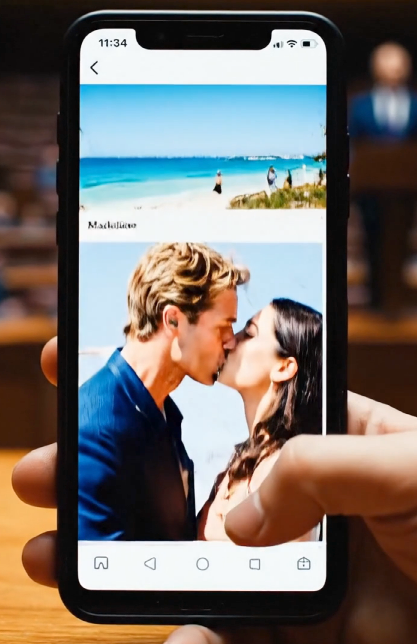
It vibrated again. Then again. A notification crawled across the screen she’d left face-up on the desk — a habit she would spend years regretting.
The first photograph showed a beach she recognized immediately. Cancún. The private resort where she and Joshua had honeymooned seventeen years ago. The second photograph showed her husband of those seventeen years — Joshua Marchetti, forty-eight, handsome in the lazy, effortless way that had always made her trust him too completely — his hand resting on the lower back of a woman in a red swimsuit. The third photograph removed all doubt. Madeline. Her Madeline, with her copper curls and her loud laugh and her standing invitation to Sunday dinners, kissing Riley’s husband with the ease of people who had been doing it for a very long time.
The diplomat’s voice continued in her ear: “—the moral clarity to act when it matters most.”
Riley’s mouth stopped moving.
For three seconds — an eternity in simultaneous interpretation — the feed went silent. A UN supervisor turned sharply toward the booth. A delegate touched his earpiece in confusion.
Then Riley Marchetti straightened her spine, pressed her lips to the microphone, and finished the sentence in flawless French, Spanish, and Mandarin before anyone could reach for a backup translator.
The women’s restroom on the fourth floor of the UN building was empty at 2:17 in the afternoon. Riley locked the stall, sat on the closed lid of the toilet seat, and allowed herself exactly eleven minutes to come apart. She cried silently, the way women who have always been composed cry — shoulders shaking, one hand pressed hard against her mouth, tears falling straight down without any drama.
She thought about seventeen years of mortgage payments. Seventeen years of Joshua’s work shirts folded on the chair. She thought about Madeline sitting at her kitchen table drinking coffee, asking “How’s things, honestly?” with those wide, concerned eyes. She thought about every conversation she’d ever had about her marriage, handed directly to the man who was destroying it.
At minute twelve, she stood up, ran cold water over her wrists, and looked at herself in the mirror for a long time.
“Alright,” she said quietly to her reflection. “Alright.”
That evening, Joshua was grilling salmon on the terrace when she came home. He looked up and smiled — that open, uncomplicated smile she had once loved without reservation.
“Long session?” he asked.
“Quite the speech today,” she said, and kissed his cheek. “It smells wonderful.”
She set the table with the good plates.
The plan assembled itself over the following two weeks with the quiet efficiency of a translation — piece by piece, each word placed exactly where it would cause the most meaning.
Dominic Hale was twenty-nine, Madeline’s nephew, recently returned from Barcelona with a law degree and the restless energy of someone who hadn’t yet decided what to do with his life. He was tall, dark-eyed, and slightly lost — three qualities Riley had always known how to work with. She ran into him at the farmer’s market on a Thursday morning, accidentally, in the way that requires significant preparation.
“Riley,” he said, surprised and clearly pleased. “You look — I mean, hi.”
“Dominic.” She smiled at him the way she had never smiled at him before. “You’ve been back a month and you haven’t called. I’m almost offended.”
He laughed, uncertain and flattered in equal measure. “I didn’t think you’d want to hear from me, honestly.”
“People are full of surprises,” she said simply, and handed him her card.
By October, they were having dinner twice a week at a quiet restaurant in SoHo where nobody knew either of them. Dominic was infatuated in the way people become infatuated with those who listen carefully and never seem to need anything. Riley listened. She asked about his professional situation, Madeline’s financial arrangements, the family properties held jointly through the Hale estate trust — all with the gentle curiosity of someone who simply found him fascinating.
Madeline had three properties registered under the family trust: a Manhattan apartment, a Connecticut house, and a commercial space generating steady rental income. Through his role as co-trustee — Madeline’s own clever legal arrangement, now turning cleanly against her — Dominic held significant authority over the estate’s direction.
The legal restructuring took six weeks. Dominic signed everything Riley suggested, with the helpless compliance of someone who believed he was building a future.
“This protects the assets long-term,” Riley told him over candlelight, tracing her finger along a document margin. “Your family will thank you eventually.”
“I trust you,” he said.
She smiled warmly. “I know.”
On a cold Tuesday in December, Riley ended it.
They were sitting in his car outside her building. “I think we both know this has run its course,” she said, not unkindly, with the same professional finality she used to close a translation session. “You deserve someone who can give you everything, Dominic. I genuinely mean that.”
He stared at her. “I don’t understand. Last week you said—”
“Last week was last week,” she said quietly. “I’m sorry.”
She was out of the car before he could find the words.
She told Joshua to leave on a Wednesday. She had gathered everything — photographs, hotel receipts, two years of evidence assembled with methodical patience. She set it all on the kitchen table between them like a completed document.
Joshua went pale. Then red. Then he tried three different sentences that all collapsed before they finished.
“Riley, listen — it wasn’t — you have to let me explain—”
“I think,” she said, in her clearest professional voice, “you should take what fits in two suitcases. The locks change Thursday.”
When Madeline called the following week — breathless, panicked, asking about the trust restructuring, about the properties, about what had happened to everything she had carefully built — Riley listened to the whole thing before answering.
“I’m sorry, Madeline,” she said. “I really am. But I’m quite busy right now.”
A long silence stretched between them.
“Riley — did you—” Madeline began.
“Take care of yourself,” Riley said, and ended the call.
Marchetti International Translation Services opened its doors in March, in a clean bright office in Midtown with floor-to-ceiling windows and a team of twelve interpreters Riley had personally recruited from diplomatic firms across three continents. The company’s specialty — high-stakes simultaneous interpretation for government and private sector clients — filled a gap in the market that Riley had spent twenty years studying from the inside.
She stood alone in the empty office the evening before the launch, city lights spreading out below her like a map of everywhere she intended to go, and felt something she hadn’t experienced in years — not happiness exactly, but something sharper and more reliable.
Clarity.
The future, as the diplomat had once said through her voice, belonged to those with the moral courage to act when it mattered most.
Riley had always had excellent timing.
Leave a Reply