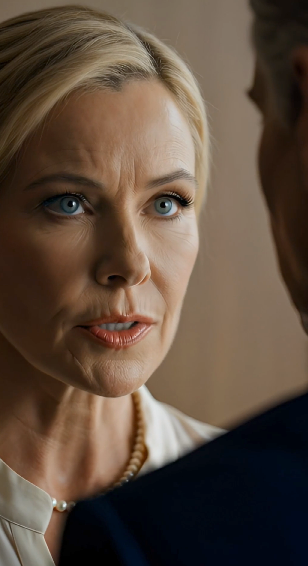
The day Victoria Harmon discovered her husband’s affair, she was wearing pearls.
She had dressed carefully that morning — cream blouse, tailored slacks, the string of pearls Richard had given her on their tenth anniversary — because she’d planned a surprise lunch at his downtown office. Twenty-two years of marriage. She still brought him sandwiches. She still believed in small gestures.
She rode the elevator to the fourteenth floor of Harmon Consulting Group — his company, built on her father’s seed money, a fact Richard had spent a decade quietly erasing from the official story. The receptionist, a nervous young man named Tyler, went pale when he saw her.
“Mrs. Harmon — he’s — actually in a meeting—”
Victoria smiled the way only a woman who has survived two decades of quiet humiliation knows how to smile: beautifully, and without warmth.
She opened the door.
Lauren Briggs was twenty-nine, copper-haired, and ambitious in the particular way that mistakes confidence for entitlement. She’d joined Harmon Consulting eight months ago as a senior analyst. She wore her blazers unbuttoned one button too many and laughed at Richard’s jokes three seconds after everyone else — long enough to seem genuine, short enough to seem smart.
She was sitting on the edge of his desk when Victoria walked in.
Not even a desk you could mistake for innocent. On it. His hand resting on her knee like a paperweight.
Richard Harmon — fifty-four, silver-templed, the kind of handsome that photographs well at charity galas — stood up so fast his chair rolled into the window.
“Victoria. This isn’t—”
“Don’t,” she said. One syllable. Quiet as a guillotine.
Lauren had the decency to look ashamed. Or something close to it. She slid off the desk and straightened her blazer, and Victoria watched her with the calm, total attention of a woman cataloguing evidence.
“You should leave,” Victoria told her. Not cruelly. Almost gently. The way you speak to someone you’ve already decided doesn’t matter.
Lauren left.
Victoria didn’t cry in the car. She didn’t cry at home, in the vast, architect-designed kitchen Richard had let her decorate because it was the one domain he considered harmless. She poured herself a glass of water, stood at the counter, and thought with extraordinary clarity.
She called Daniel Moss — not her therapist, not her sister. Her lawyer.
“Daniel,” she said, “I need everything. The prenuptial clause about infidelity. The business valuation from March. And the name of the best forensic accountant in the city.”
A pause. “Victoria, are you sure you want to—”
“I want forty percent of Harmon Consulting, the house in Connecticut, and his dignity. In that order.”
What followed was six months that Richard would later describe — to anyone who’d still listen — as a coordinated devastation. Victoria had spent two decades watching him run that company. She had attended every board dinner, remembered every partner’s wife’s birthday, absorbed every strategic conversation Richard had dismissed as “just shop talk, darling.” She had been, it turned out, paying ferocious attention.
The divorce settlement was filed on a Tuesday. By Thursday, three board members had quietly reached out to Victoria directly — men who had always respected her father’s legacy more than Richard’s borrowed confidence. By the following month, a shareholder vote had been called.
Richard sat in the boardroom where his name was still on the wall and watched his wife take the chair at the head of the table.
“You can’t do this,” he said. The silver temples suddenly looked less distinguished. Just gray.
“I already have,” said Victoria.
Lauren Briggs was terminated the same week — restructuring, the official memo said. She found that no reference materialized, that the industry felt suddenly, inexplicably small, and that Richard — stripped of company, Connecticut house, and relevance — had nothing left to offer anyone. He moved to Phoenix. He called her once. She didn’t answer.
She had gambled on a powerful man and discovered, too late, the oldest lesson: power is not the man. Power is whoever holds the documentation.
The unexpected grace note arrived eighteen months later, at a charity gala ironically hosted by Harmon Consulting — now simply Harmon Group, under Victoria’s direction, up twenty points in quarterly revenue.
She was introduced to James Briggs — Lauren’s ex-husband, recently and quietly divorced, an architect with honest eyes and absolutely no tolerance for dishonesty, for reasons that required no explanation between them.
They stood at the edge of the room, two people holding champagne flutes and a shared, unspoken understanding of exactly what it costs to trust the wrong person.
“I’ve heard a great deal about you,” he said.
Victoria smiled — differently this time. Warmly. Real.
“None of it good, I imagine.”
“All of it,” he said, “was impressive.”
They married on a Saturday in April. Small ceremony. No pearls — she’d sold them. She wore diamonds she’d bought herself.
Lauren Briggs watched the announcement on LinkedIn, alone in a studio apartment, still waiting for a callback.
Justice, Victoria had learned, rarely announces itself.
It simply arrives — dressed impeccably, holding the controlling shares.
Leave a Reply