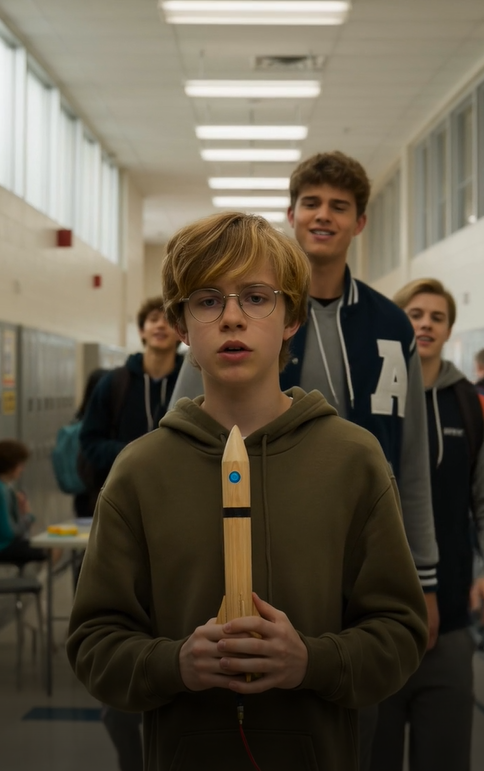
The day Tyler Marsh walked into Crestwood High carrying a homemade rocket model for the science fair, he had no idea it would be the last day anyone would ever laugh at him.
He was sixteen, pale and lanky, with sandy brown hair that never quite sat right and wire-framed glasses he’d had since eighth grade. He wore the same olive-green hoodie almost every day — not because he didn’t own other clothes, but because it had a pocket deep enough to carry a book. He was always reading. That, more than anything, was the problem.
The hallway outside the gym was wide and merciless. Tyler walked through it with his rocket model held carefully against his chest — three weeks of labor, balsa wood and aluminum foil and a real functional ignition switch he’d wired himself. It was beautiful, in the way only something made with obsession can be.
He didn’t see Chad Reeves until it was too late.
Chad was everything Tyler wasn’t: six feet tall, broad-shouldered, with a jaw like a movie poster and a laugh that seemed to fill every room he entered. He was the starting quarterback, the homecoming king, and the undisputed center of Crestwood’s social universe. He was also, in the most casual and devastating way possible, cruel.
“Whoa, whoa, whoa.” Chad stepped directly into Tyler’s path, flanked by his two constants — Devon Walsh and Marcus Hill, both football players, both wearing the same lazy grin. “Is that a rocket ship, Marsh? You going back to your home planet?”
Laughter cracked through the hallway like a gunshot. A dozen students stopped to watch. Tyler felt his face go hot.
“It’s for the science fair,” he said quietly.
“The science fair.” Chad repeated it like it was the punchline to a joke Tyler hadn’t heard yet. He reached out and flicked the nose cone of the rocket, hard. “Does NASA know about this? Should we call them? Hey Devon — should we call NASA?”
“Definitely call NASA,” Devon said, grinning.
More laughter. Someone filmed it on their phone. Tyler stood still, holding his rocket, saying nothing. That was what he always did — stood still, said nothing, waited for it to pass. It always passed.
But this time, Chad took one step forward and, with the flat of his palm, shoved the rocket clean out of Tyler’s hands.
It hit the linoleum floor with a crack that Tyler felt in his chest.
The ignition wire snapped. The nose cone shattered. Three weeks of work, gone in a second. Tyler stared at the pieces on the floor. Around him, the laughter grew. He knelt slowly, began picking up the fragments with shaking hands.
“Aw, don’t cry, rocket boy,” Chad said, and walked away.
Tyler didn’t cry. Not there. He gathered every piece into his backpack, walked to the bathroom at the end of the hall, locked himself in a stall, and sat on the closed lid of the toilet with his hands pressed flat against his knees until the shaking stopped.
Then he took out a notebook and started writing.
He wrote everything — dates, times, names, incidents. The day Chad knocked his lunch tray out of his hands in October. The time Devon drew on his locker with permanent marker. The week Marcus and his friends followed him home every single day, calling his name in falsetto. He’d been writing it all down for eight months. Every word, every laugh, every casual and studied humiliation.
He also pulled up a website on his phone — one he’d bookmarked three weeks ago. The Crestwood County Regional Science Competition. Open to all high school students. Prize: a five-thousand-dollar scholarship and a feature in the state education newsletter, distributed to every college admissions office in the state.
Tyler looked at the broken rocket in his bag. Then he looked at the notebook.
He started making a new plan.
The science fair was held six weeks later in the school gymnasium. Tables lined with poster boards and experiments stretched from wall to wall. Chad Reeves showed up with a volcano — the same baking soda and vinegar eruption that children had been presenting since 1987. He was also on the committee that chose the winner. His father was on the school board.
Tyler presented something entirely different.
His table held a laptop, a small camera, a custom-coded facial recognition program, and a thick binder. On the laptop screen, a live graph updated every few seconds, its lines spiking and falling as the program processed data. Around the table, a crowd had gathered — not students, but the three judges, including Dr. Patricia Coleman, who chaired the county’s STEM initiative and had driven forty minutes from the state university to attend.
“What is this?” Dr. Coleman asked, leaning in with genuine curiosity. She was in her fifties, sharp-eyed, with silver-streaked hair and the posture of someone who did not suffer nonsense.
“It’s a behavioral pattern recognition system,” Tyler said. His voice didn’t shake. He’d been rehearsing for six weeks. “I trained it on six months of hallway security footage, with permission from the district’s IT administrator.” He slid a signed authorization form to the front of the binder. “It identifies repeated patterns of targeted physical and verbal aggression — what researchers call relational and direct bullying — and maps the social network around the behavior.”
He clicked to the next screen. A web of names appeared, connected by red lines, each line labeled with a date and incident type. In the center of the web, three names glowed larger than the others.
Dr. Coleman went very still.
“This is a real data set?” she asked.
“Yes,” Tyler said. “From this school. This year.”
Across the gymnasium, Chad Reeves was laughing about something with Devon Walsh. He hadn’t even looked at Tyler’s table. He didn’t need to. He’d already decided how this day would end.
He was wrong.
Tyler didn’t win the science fair. He won something far more permanent.
Dr. Coleman stayed at his table for forty-five minutes. She asked questions he answered without hesitation. She photographed the binder, photographed the program, asked for his contact information. Before she left, she gave him her card.
“I’m going to connect you with a graduate researcher at my institution,” she said quietly. “This methodology has real academic applications. I’d like to see it developed properly.” She paused, looking at the name web still glowing on his screen. “And I’ll be forwarding this data to the district superintendent this afternoon.”
Tyler nodded. “There’s a copy already waiting in his inbox,” he said. “I sent it this morning.”
Dr. Coleman looked at him for a long moment, the way adults sometimes look at young people they’ve badly underestimated. Then she smiled.
Chad Reeves left the science fair with a second-place ribbon and a vague sense that something had shifted in the air, though he couldn’t name it. He found out what it was eleven days later, when he was called into the principal’s office alongside Devon Walsh and Marcus Hill, and handed a formal disciplinary notice while a district administrator sat in the corner taking notes.
Tyler was not in that room. He was at home, video-calling a graduate student named Rachel Wu at the state university, discussing the ethics and methodology of his program. On his desk was a letter confirming his five-thousand-dollar scholarship. On his laptop screen was a new notebook file, blank and waiting.
He was already writing the next thing.
Leave a Reply