The blood was Cassidy Marlowe’s own, and nobody was supposed to see it.
She had been standing at the top of the auditorium stairs — perfect, golden, untouchable as always — when her heel snapped and she went down hard on the marble landing. A gash opened across her palm from the metal railing edge. It wasn’t serious. It was just visible. And in the ten seconds before she could compose herself, before she could reconstruct the armor, Morgan Ellis saw her face — the raw, unguarded flash of it. The fear. The smallness underneath.
That was the problem.
Cassidy had spent two months making Morgan’s life a slow, quiet demolition. And now Morgan had seen something she was never supposed to see.
Morgan Ellis was the kind of girl who existed in the margins of Westfield High — brown hair, secondhand Converse, the permanent posture of someone who had learned to take up less space. She had made one fatal error in October: turning in a short story that Mr. Hartley called “the most alive writing I’ve seen from a student in eleven years.” He said it in front of everyone. Cassidy heard every word.
Since then, Morgan’s locker had been defaced twice. Her lunch table had been colonized and then abandoned, leaving her eating alone by social quarantine. Anonymous accounts posted screenshots of her old Facebook photos — the awkward ones from eighth grade — with captions Cassidy never wrote herself but always approved with a single laugh.
Morgan had survived it by becoming very still, the way small animals survive predators. Don’t run. Don’t react. Wait.
But now she was standing at the bottom of those auditorium stairs, watching Cassidy Marlowe bleed, and Cassidy was watching her watch it, and both of them understood something had shifted permanently in the architecture between them.
“Don’t,” Cassidy said. Her voice was low, stripped, nothing like its usual music. She was pressing her blazer against her palm. A dark stain spreading through white fabric.
“Don’t what?” Morgan asked.
“Don’t look at me like that.”
“Like what?”
“Like you know something.”
Morgan tilted her head. “You need to go to the nurse.”
“I know what I need.” Cassidy stood straighter, reassembling herself in real time — chin up, shoulders squared, the performance reconstructing itself like a broken bone snapping back into place. Behind her, Hailey Voss and Britt Connors were rounding the hallway corner, not yet close enough to have seen anything. Cassidy’s eyes cut to them, then back to Morgan, sharp and fast as a blade.
“Not a word,” she said quietly.
Morgan looked at her — really looked, the way a writer looks, noting everything. The ruined blazer. The hand trembling slightly. The strange, naked desperation in a face that was never supposed to need anything from anyone.
“Or what?” Morgan said. “You’ll make my life worse? Cassidy.” She almost laughed. “You’ve already done everything.”
The silence between them lasted four full seconds. Long enough to be geological.
Then Hailey arrived, bright and oblivious. “Oh my God, Cass, what happened?” She grabbed Cassidy’s arm, steering her toward the nurse, already narrating the story — the railing literally just gave way, it’s a liability issue, someone could sue — and Cassidy let herself be carried by it, by Hailey’s noise and the familiar current of being someone people rushed toward.
But she looked back once.
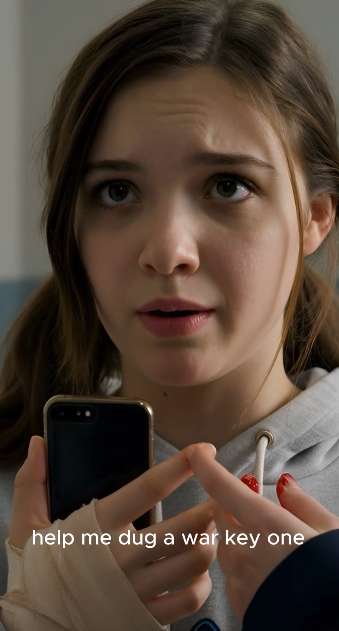
Morgan was still standing there. Not triumphant. Not cruel. Just watching with those quiet, precise eyes, and holding, Cassidy realized, her phone.
Morgan had not taken a photo.
She almost had — the impulse had been there, immediate and electric, the sudden power of it after weeks of powerlessness. Her thumb had hovered. She had felt the weight of it, what it would mean to post it. Cassidy Marlowe bleeding on the auditorium stairs. The comments would write themselves. The reversal would be total and swift and devastating.
She put her phone back in her pocket.
Not because she was afraid. Not because she was kind, exactly. But because she had written enough stories to know that becoming Cassidy was the one ending she couldn’t survive.
What Morgan did instead was write.
She wrote the whole thing down that night — not as a weapon, but as a document. The two months. The locker. The lunch table. The look on Cassidy’s face at the top of the stairs. She wrote it plainly, without hatred, the way you write something true that costs you something to say. She turned it in to Mr. Hartley Friday morning under the assignment title: Something Real.
He read it at his kitchen table Thursday night. He sat very still afterward for a long time.
By Friday afternoon it was in Principal Crawford’s hands.
By Monday, Hailey Voss and Britt Connors had been suspended pending an investigation into the anonymous accounts — traced by the district’s IT coordinator to Hailey’s home network in under an hour.
Cassidy was called to Crawford’s office alone. She walked in with her yearbook smile. Crawford slid the essay across the desk without a word and watched Cassidy read it. The smile held for almost a full page. Then something moved behind her eyes — tectonic, irreversible — because Morgan hadn’t called her a monster. Hadn’t exaggerated. Had simply described her, clearly, precisely, the way you describe a thing you have studied without flinching.
Cassidy looked up. Her hand — still bandaged — pressed flat against her knee.
“She had every right to post that photo,” Crawford said. “She didn’t. Think about why.”
Three weeks later, Morgan was eating at a real table — not the stairwell, an actual table with actual light — when Cassidy sat down across from her without asking, without audience, without the performance.
Her hand was healed. Her eyes were doing something unguarded.
“You had it,” Cassidy said. “The photo. You had everything.”
“I know,” Morgan said.
“Why didn’t you use it?”
Morgan considered her. Outside, the November sky pressed grey and indifferent against the cafeteria windows. “Because I didn’t want to write that story,” she said. “I already knew how it ended.”
Cassidy was quiet. Around them the cafeteria churned with its ordinary noise, indifferent, moving on.
“Your writing,” Cassidy said finally, her voice stripped down to something almost unrecognizable — almost real. “It’s actually — I read your story. The one Hartley read out loud.” She stopped. Started again. “It was the best thing I’ve ever read from someone our age.”
Morgan looked at her for a long moment. “I know,” she said again. “That was always the problem.”
They didn’t become friends. But something closed between them — some open wound in the social order of Westfield High — quietly, without ceremony, the way the best endings happen.
Popular kids don’t bleed in public.
Until the right person decides not to make them.
Leave a Reply