The office holiday party was in full swing when I realized my entire career was about to collapse—and my best friend Emily was the one holding the sledgehammer.
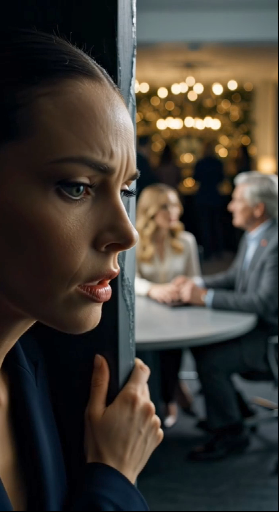
I stood frozen in the hallway outside the executive conference room, my hand still on the door I’d just cracked open. Through the gap, I could see Emily—blonde, perpetually cheerful Emily with her infectious laugh and her “we’re in this together” pep talks—sitting across from our VP of Operations, David Brennan. Between them sat a leather portfolio I recognized immediately. My portfolio. The one containing my pitch for the Morrison Tech account.
“I’ve been working on this strategy for three months,” Emily was saying, her voice stripped of its usual warmth, replaced by something calculated and cold. “The key is the sustainable packaging angle. Morrison’s board is obsessed with their environmental image.”
My sustainable packaging angle. My research. My late nights and weekend work.
David, a silver-haired man in his fifties with sharp features and sharper instincts, leaned back in his chair. “This is excellent work, Emily. If you pull this off, we’re looking at a senior account manager position. Maybe even junior partner track.”
The promotion I’d been killing myself for. The promotion Emily knew I desperately needed—I’d just put my mother in an assisted living facility that was draining my savings.
I must have made a sound, some small gasp of betrayal, because Emily’s head snapped toward the door. Our eyes met through the gap. For a split second, I saw something flicker across her face—guilt, maybe, or fear—before it hardened into defiance.
I ran.
The next morning, I arrived at work two hours early, my eyes gritty from a sleepless night. I’d spent hours replaying every conversation, every coffee run, every “you’ve got this!” text message Emily had sent over the past year. We’d started as cubicle neighbors and became inseparable. She’d met my mother. I’d helped her move apartments. We’d coined ourselves “the dynamic duo.”
All of it had been reconnaissance.
I unlocked my computer and pulled up my original files, my hands shaking. Then I began to dig.
Emily had been clever—she’d taken my framework and reworded it, changed the formatting, made it look different enough to pass casual scrutiny. But the data points were identical. The client research. The projected ROI figures down to the decimal point. Even the implementation timeline matched mine exactly.
But as I scrolled through my archived emails, something else caught my eye. A message thread from three months ago, when I’d first been assigned the Morrison Tech preliminary research. I’d copied Emily on it, like I copied her on everything, because that’s what friends did.
Except Emily had forwarded it. To David’s executive assistant, Lauren, with a message: “Thoughts on this approach? Wanted to run it by you before developing further.”
The timestamp: two days after I’d shared it with Emily.
My stomach turned. This wasn’t impulsive. This was premeditated.
I kept digging, my fingers flying across the keyboard. Email after email, a trail of breadcrumbs showing Emily’s careful cultivation of executive relationships, her strategic positioning, her patient theft of my work disguised as “collaboration” and “bouncing ideas around.”
Then I found it. The smoking gun.
An email from Emily to David from six weeks ago: “Per our conversation, I’m pulling together the Morrison pitch. Jessica’s been helpful with some of the preliminary research, but I think the strategic vision needs to be tightened. I’ll have something ready by December.”
Helpful with preliminary research. As if I’d been her assistant.
I heard her voice before I saw her—that bright, false cheer echoing down the hallway. “Jessica! Hey! You weren’t at the party last night. Everything okay?”
I turned slowly from my desk. Emily stood there in her cream blouse and perfectly pressed slacks, holding two coffee cups from the expensive place downtown. She extended one toward me, her smile warm and concerned.
“Peppermint mocha, extra whip. Your favorite.”
I didn’t take it. “I was at the party, Emily. Just didn’t stay long.”
Something flickered behind her eyes. “Oh? I didn’t see you.”
“No,” I said quietly. “You were busy.”
The silence stretched between us like a wire pulled taut. Finally, Emily set both coffees down on my desk, her movements careful. “Look, Jessica. The Morrison account—”
“Is mine,” I interrupted. “You know it’s mine.”
She had the audacity to look hurt. “We’ve been collaborating—”
“Collaborating?” My voice cracked. “Emily, I trusted you. With everything. You’ve been stealing my work for months, and you knew—you knew—how much I needed this promotion.”
Her face hardened. “That’s not fair. We shared ideas. That’s what teams do.”
“Teams don’t take credit for each other’s work.”
“And friends don’t get jealous and territorial,” she shot back, her nice-girl mask finally slipping. “Maybe if you spent less time complaining about your problems and more time networking like I do, you’d be the one in that conference room.”
The words hit like a slap. Before I could respond, she grabbed her coffee and walked away, her heels clicking sharply against the floor.
The Morrison Tech presentation was scheduled for Friday. Emily spent the week preparing, her confidence radiating through the office. I watched her rehearse in the glass-walled conference room, saw David nodding approvingly, heard whispers about her “star potential.”
I said nothing. Did nothing. Just kept my head down and worked.
Friday morning arrived cold and gray. The presentation was set for 10 AM. At 9:45, David called an all-hands meeting.
“Change of plans,” he announced, his expression unreadable. “We’re going to hear from Jessica Morrison—I mean, Jessica Thompson—sorry, I had Morrison on the brain.” A few people chuckled. “Jessica, you’re up.”
Emily’s head whipped toward me, her face draining of color. “What? David, we discussed—”
“Sit down, Emily.” His voice was ice.
My hands trembled as I connected my laptop to the projector, but my voice stayed steady. I walked the room through my strategy—my strategy—for the Morrison Tech account. The sustainable packaging initiative. The three-phase implementation plan. The projected 40% increase in their market share.
When I finished, the room was silent.
Then David spoke. “Excellent work, Jessica. Truly excellent.” He turned to Emily, whose face had gone from white to red. “Emily, would you like to explain why the presentation you showed me Wednesday was virtually identical to what we just heard?”
“I—we collaborated—”
“I’ve reviewed the email trail Jessica provided me,” David continued, his voice cutting. “All of it. Including your communications with my assistant, in which you repeatedly positioned yourself as the strategic lead while Jessica was doing the actual work.”
Emily’s mouth opened and closed soundlessly.
“Clear out your desk,” David said quietly. “HR will be in touch about the termination paperwork.”
Emily left without looking at me. I heard later she’d tried to spin a story at her next interview about “creative differences” and “hostile work environments,” but in our industry, word travels fast.
I got the promotion. And the Morrison account, which turned into a seven-figure relationship for our firm.
But sometimes, late at night, I still think about those coffee runs, those “you’ve got this!” texts, those moments I thought I’d found a real friend in the fluorescent-lit wasteland of corporate America. The betrayal still stings—not just that she stole from me, but that she did it while looking me in the eye and calling me her best friend.
I’ve learned my lesson, though. I’m friendly at work now. Polite. Professional.
But I never, ever trust work friends again.
Not after Emily.
Leave a Reply